

Most people go to Tucson, Arizona in January for its bright sunny skies. Henk and I went there for the dark inky ones. We even drove up to more than 9,100 feet above sea level to get a closer look at the heavens from the top of one of the area’s Sky Islands. Wait, “what’s a Sky Island” you might ask? Well, read on about the best place to go stargazing in Tucson.
Southern Arizona is Dark Sky Central
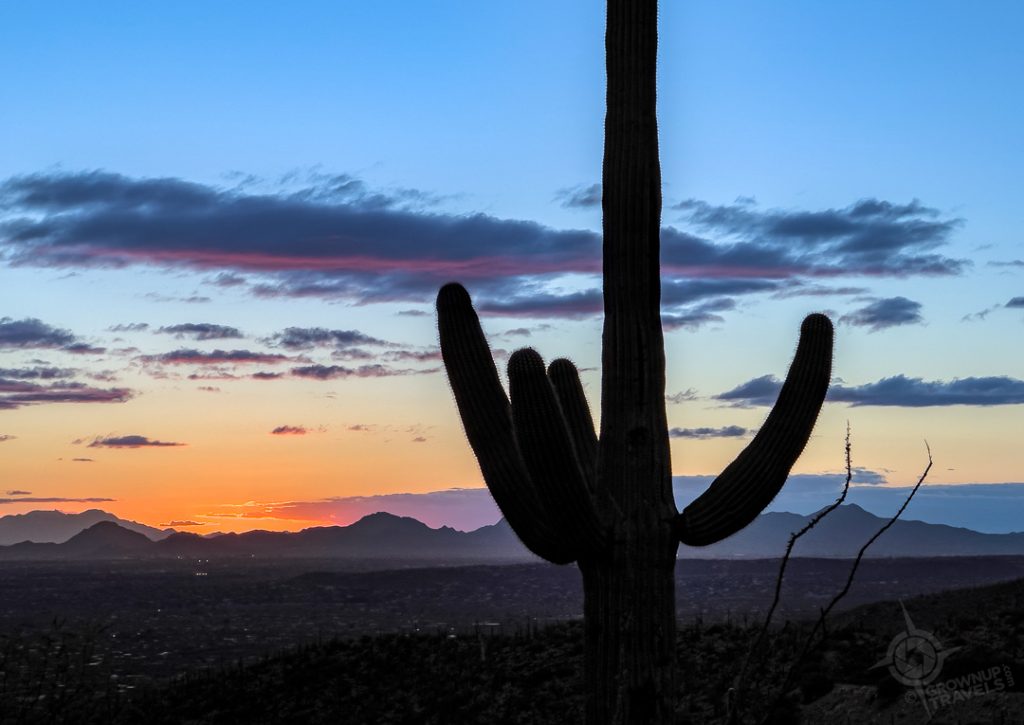
Tucson is known for its dark desert skies and low light pollution
Southern Arizona and Tuscon in particular are renowned for their dark skies. Not just dark as in the “oh, we are in the desert, look at the stars” kind of dark skies – seriously dark skies, as measured by international dark sky associations. The kind of dark skies where there are no street lights in the residential neighbourhoods of Tucson, and where businesses aren’t allowed to use uplighting. In fact, Tucson was the first city in the world to implement ‘Dark Sky ordinances’ in the 1970s in order to safeguard the night sky for astronomical activities. It’s part of the reason why the global authority on light pollution, Dark Sky International, have their headquarters here.
That intentional reduction of light pollution is also why there are 5 world-class observatories within an hour’s drive of Tucson, making this one of the astronomy capitals of the world, alongside the Atacama Desert in Chile. Plus this area of Arizona is home to a very specific desert climate with little precipitation and close to 300 clear nights on average annually – another reason why Henk and I chose to go stargazing in Tucson. Because it’s not enough that the skies need to be dark: they need to be cloudless, too.
Where to go Stargazing in Tucson
SAGUARO NATIONAL PARK
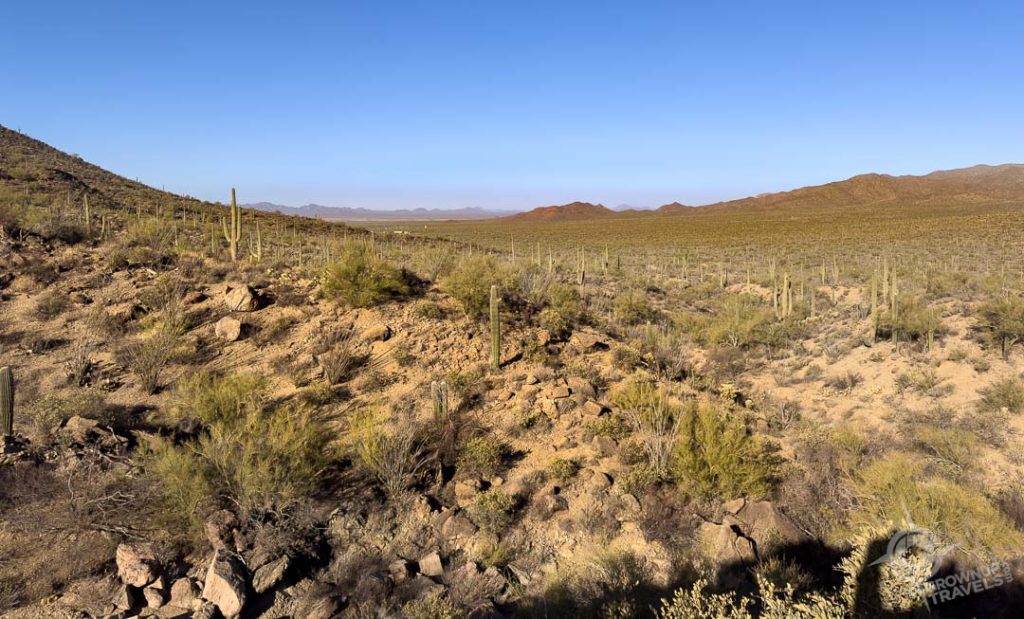
Saguaro National Park (West) offers expansive views day or night and is just outside of Tucson
Tucson is surrounded on two sides by 70,000 acres of desert wilderness – Saguaro National Park – which is a great place to start if you are looking for places to get starstruck in Tucson. Having access to an unpopulated area without having to drive hours from where you might be sleeping is a huge bonus and not many cities as large as Tucson offer this kind of proximity to undeveloped wilderness. Which is why in 2023, the Park was even named the world’s ninth Urban Night Sky Place, recognizing its commitment to protecting dark skies while still being so close to an urban centre. Since Tucson conforms to its own Dark Sky restrictions, this is the best of both worlds.
TIP: Saguaro National Park is open 24 hours to walk or bike in. If you are driving, entrance gates to Saguaro East (Rincon) close at 8:30 pm but if you are already in the Park, you can still exit after that time (the gate will sense your car and lift). Which is why we would recommend this section for stargazing.
The hours for entrance to Saguaro West are different and change seasonally, so just to be sure, check the website AND with the ranger at the gate so you don’t find yourself locked INSIDE after hours.
FOLLOW THE ‘ASTRO TRAIL’ BY VISIT TUCSON
Along with its surrounding acres of wilderness park, international dark sky designations and clear nights, Tucson is also one of the few places in the world offering programs and activities that actively promote stargazing – including providing access to massive scientific telescopes. To that end, Visit Tucson just launched their own brand new ‘Astro Trail’ guide that helps night sky enthusiasts and ‘astro-tourists’ easily find these activities and places for themselves.
The Trail includes a list of 11 places in and around Tucson where visitors can check in, earn points that can be redeemed for prizes (water bottles, stickers, etc) and even take advantage of discounts on gift shop merchandise or admission prices to some of the locations. More importantly, you can visit each location’s website and see what they offer individually in terms of public programming. For example: Oracle State Park regularly hosts Star Parties that are free with park admission; there is a giant Mirror Laboratory that you can tour at the University of Arizona to see how massive 8-meter-wide lenses are manufactured and used in astronomy; and Mt. Lemmon SkyCentre offers a 5-hour SkyNight experience that offers visitors the chance to gaze through their 32-inch Schulman telescope. THIS was the experience Henk and I were keen to do.
Our Destination: Mount Lemmon SkyCentre
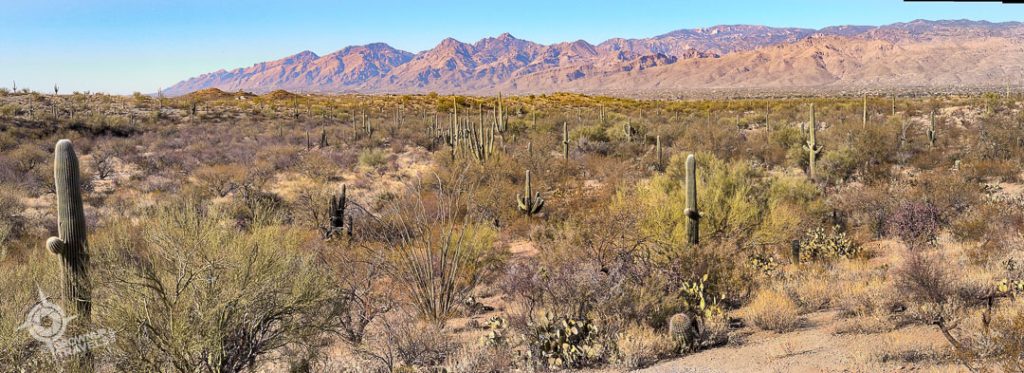
The Santa Catalina Mountains start just to the north of Tucson (this view from Saguaro National Park East)
The Mount Lemmon SkyCentre is located on the top of the highest peak in the Santa Catalina Mountains, just outside of Tucson. Originally established by the U.S. Airforce as the highest radar station in the country, after the base was de-commissioned in 1970, the Steward Observatory from the University of Arizona used the facilities to operate astronomical field facilities. And in 2010 the University got involved in educational programming for both students and the general public with their Mt. Lemmon SkyNight astronomical programming.
The University has also created a free audio guide, the Mt. Lemmon Science Tour, that makes a great introduction to any SkyNight event, because it educates visitors during their drive up through the Santa Catalina Mountains to the peak of Mt. Lemmon. Henk and I downloaded the app which provided descriptions of various stops along the way as well as interesting information about the geography, climate, flora and fauna of this very specific region of Arizona as we ascended from 2,400 to almost 9,200 feet above sea level.

Spectacular views from Windy Point lookout en route to Mt Lemmon. Notice how the hills are getting greener.
It was while listening to this audio tour that Henk and I first heard the term “Sky Islands” used to describe these particular mountain ranges that are found in southern Arizona and Northern Mexico.
So, What is a Sky Island, Exactly?

The term ‘Sky Island‘ immediately conjures up images from the movie Avatar: green, floating islands suspended in mid-air high in the skies above the planet Pandora. While the Santa Carolina mountains aren’t exactly levitating in space, they have been described by some as ‘a mountain island in a desert sea”. Surrounded by desert flats, the sudden rise in elevation of these tall mountains results in a unique habitat for both flora and fauna that changes dramatically from base to peak.
In the space of 90 minutes, we travelled vertically from Tucson’s hot, arid desert basin with its saguaro cacti and scrubby desert plants up through a woodland habitat with deciduous trees, and eventually into a spruce-fir-aspen forest with snow still visible in the shadows of the pines. The temperature, too, dropped by more than 20 degrees. From a ecological standpoint, it was like travelling from central Mexico to British Columbia in less than 2 hours.
What to Expect at a Mt. Lemmon SkyNight Event
After parking just outside the gates leading to the SkyCentre near Mt. Lemmon Ski Valley (yes, Tucson actually has a ski resort here!), our group of wanna-be astronomers were escorted the rest of the way up to where the Observatory is situated. Here, we were given an orientation and description of the site by our two hosts for the evening: Roswell “Roz” Roberts, a U of A student pursuing advanced degrees in Astronomy, Physics and Math; and Jeronimo Cruz, an electrician by trade who has taken his passion for amateur astronomy to the next level by building observatories and hosting public outreach programs like this one. Roz and Jeronimo made a good team because both men were able to answer a wide range of questions from beginner to expert, making the experience inclusive and informative for everyone in the group.
Arriving before sunset, we had the luxury of time before the stars emerged to observe sun flares and sunspots through the Observatory’s special solar telescopes. These scopes are specially designed to protect the human eye, so whatever you do, don’t try this at home with other devices.

Jane looking through Solar telescopes at Mt. Lemmon SkyCentre
After watching the sun set from our 9100-foot-high vantage point, ‘astronomical twilight’ arrived (the time when planets and stars begin to appear), and using the binoculars provided to us when we arrived, Jeronimo led us on a guided exploration of the sky. There wasn’t a whisper of a cloud anywhere, so there was nothing to obscure the tens of thousands of stars as they took over the sky above us, so dense that even familiar constellations were difficult to pick out from amongst them.
With full darkness came time for the main attraction – the chance to view astronomical objects through a 32-inch Schulman telescope. This telescope is one of two on-site that were actually commissioned by the U.S. government as part of the Catalina Sky Survey to detect objects on collision courses with Earth (like those asteroids that might slam into us someday), so we are talking about the Real Deal here. Fun fact? These two telescopes were responsible for finding almost half of all those objects detected. (Let’s just hope someone finds the other 50%, too!)
Good Heavens
Over the course of the next 2 hours or so we had the 32-inch Schulman telescope at our disposal, and with Roz at the computer controls, and Jeronimo describing what we were seeing, we were able to view planets, stars, nebulae and deep-sky objects you could never see with the naked eye.
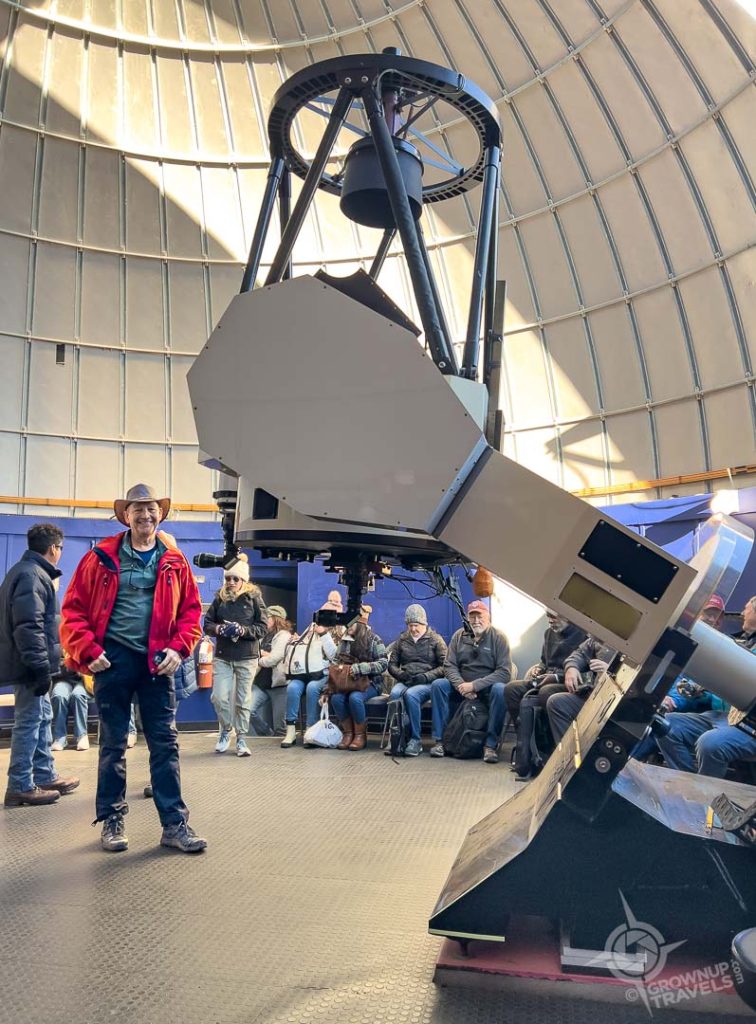
Henk beside the 32-inch Schulman telescope at Mt. Lemmon SkyCentre
Even Venus surprised all of us, because we got to see the planet in its crescent phase through the telescope (who knew Venus had phases like the moon!). Saturn never disappoints, of course, tilted on enough of an angle so that its rings were clearly visible, and although Jupiter’s Red Spot was around the opposite side, we could easily make out the banding on the planet.

But Henk was over the moon (ha!) when he got to observe the gaseous nebula in the constellation of Orion. Even the freezing temperatures couldn’t dampen his excitement at having this kind of equipment literally at his fingertips to view the nebula, and perhaps the only downside was not being able to photograph what he was seeing. He did, however, grab a shot of star trails over the SkyCentre Domes when others in our group were taking turns looking through the telescope.

A time lapse of star trails over Mt. Lemmon’s 5 observatory domes
Coming Back Down to Earth
After the excitement of an evening of ‘professional’ stargazing and peering deep into our universe, we left the telescopes and their keepers behind to return to earth, both figuratively and literally, down the long road back to the desert. Along the way, we stopped at one of the lookouts to take another moment to admire the skies. What was impressive was that even with the city of Tucson and its million inhabitants right below us, the level of light pollution was dramatically less than comparable cities, allowing the brilliance of the stars and planets to shine above it. Clearly, Tucson was doing right by its dark sky promise to preserve those views for everyone to enjoy.
A 5-Star Experience
Henk and I have been to several stunning dark sky locations around North America, but nowhere else had we been given the opportunity to combine ‘amateur viewing’ with access to professional telescopes like the ones at Mt. Lemmon SkyCentre. And with all the urban amenities and attractions of Tucson literally at the foot of the mountain, we couldn’t have chosen a better destination that offered so many day and night activities for visitors. As dark-sky getaways go, we would definitely give this one 5 stars!

Tips for Stargazing in Tucson at Mt. Lemmon SkyCentre
TICKETS: The SkyNight program must be booked in advance based on the event schedule and costs $85 per person. This includes a boxed dinner (sandwich, snack and drinks) provided in the on-site lecture room/building. Your food preferences will be taken when you register (but if you have significant allergies or food issues, talk to the staff about alternate arrangements).
CANCELLATION: Based on weather conditions, you will receive an email on the day of your event confirming if it is a go or not.
DRIVE TIME: Allow at least 90 minutes to get to the gates at the top. More if you like to stop along the way to admire the views! Late arrivals will not be accommodated.
WHAT TO WEAR: There is a 20-degree drop in temperature between Tucson and the top of Mt. Lemmon in any season. Plus there is likely to be wind, which may make the temperature feel even colder. If you are visiting in January, wear what you would if you were going skiing, including gloves, hat, insulated pants or long underwear and a winter coat. It can get seriously cold especially when there is a wind. There is a warming room inside the Dome where the telescope is located, and you can use this room while waiting to look through the telescope. But the Dome itself is open so it will be cold inside.
Special thanks to Visit Tucson who hosted Henk and I on our Mt. Lemmon SkyNight experience.

Jane is an award-winning travel writer and photographer and an accredited member of the Travel Media Association of Canada (TMAC). In their annual awards competition, TMAC named GrownupTravels.com as the Best Self-Published Travel Blog in 2025 .
She is also a member of the North American Travel Journalists Association, and a freelance travel writer contributing to both print and online publications.





Subscribe and you'll never miss an update!
Join our mailing list to receive the latest news and updates from Grownup Travels. (We keep your email STRICTLY private)
Thank you for subscribing to Grownup Travels!