

At first glance, the Atomium looks like something that belongs on the set of a sci-fi movie in a galaxy far, far away – not perched on the edge of the European Union’s capital city. After all, Brussels is home to the historic Grand Place, a Gothic and Baroque architectural gem considered by many to be one of the most beautiful squares in Europe. Yet it is its futuristic style that makes the Atomium in Brussels so intriguing, and one of the reasons why, after seeing it for the first time in a documentary, Henk and I knew it was on our must-do list if we were ever in Brussels. We weren’t the only nerds who were interested in this, apparently, since it turns out the Atomium is the most visited attraction in the city today. Here’s why this enduring symbol of the future never seems to get old.
History of the Atomium
The Atomium was built as the centrepiece of the 1958 Universal and International Exhibition in Brussels (‘Expo 58’), a global fair that would bring together the world to celebrate our collective advancements and achievements in science and technology. It was the first Fair of its kind to take place since 1939 and the onset of World War II, so this particular international exposition was also meant to usher in a renewed optimism, and a positive way of balancing humanity and science with the Fair’s theme of ‘A World View: A New Humanism’.

Advances in technology had already positioned mankind on the threshold of a new era, the Atomic Age, so it was fitting that the central structure at the heart of Expo 58 would be a scaled up version of a molecule, in this case, a 30-story-tall structure representing an iron crystal that was ‘magnified’ 165 billion times.

The Design
The ‘molecule’ design of the Atomium is imposing, standing out on the landscape in a way that no typical building could, thanks to its unique shape and construction. The entire structure rises more than 104 metres (30 stories) from the Heysel Plateau, and is composed of 9 steel spheres, each of which is 18 metres in diameter, and connected by diagonal tubes that are 29 metres long. Sunlight bounces off the spheres thanks to their reflective metal surface plates, which gives the Atomium an even more impressive presence, even from a distance. (Originally these plates were made of aluminum, which contributed to the Atominum name which was an amalgam of ‘atom’ and ‘aluminum’).
There were a number of different designs proposed for the Atomium, the brain child of engineer André Waterkeyn, who brought his vision to life with the help of architects Jean and André Polak. An early iteration imagined the entire structure, all 2400 tons of it, resting on the bottom sphere without any other supports, but wind tunnel testing showed that this would be too dangerous, so 3 pylons were added for additional stability and support. This final design was approved, and the 18-month long construction of the Atomium began, which would eventually finish ahead of schedule, at a cost of 200 million Belgian francs.

A historical display inside the Atomium included this 1957 Dolf Kruger photo taken during construction
Expo 58 opened in Brussels on April 17, 1958, and over the course of the next six months, more than 41 million visitors would flock to the city to experience the Fair, marvel at the Atomium and line up to explore its interior. Six of the spheres were open to the public, four of which were used for displays highlighting the peaceful use of nuclear energy, and the very top one housed an observation area and a 250-seat restaurant.
TIP: There is still a restaurant at the top of the Atomium today, Panoramic, which operates independently from the Atomium museum itself. Reservations are necessary, and although we can’t vouch for the food since we didn’t eat there, we can say that the views will be amazing.
After the Fair
Even though the Atomium was only designed to last six months for the duration of the World Expo, it was hugely popular and immediately became a feature on Brussels’ landscape, so much so that its demolition was postponed and then cancelled: instead, a 25-year lease was issued to keep the exhibit operating for years after the Fair ended.
Time took its toll on the structure, however, and by the late 1990s, the Atomium was looking a little worse for wear, with tarnished spheres and leaky interiors. Three levels of government decided it was worth saving, and undertook a major restoration of the structure, auctioning off the original aluminum plates that covered the Atomium to help raise money for the renovations.

The Restoration
New stainless steel plates which were more durable than the aluminum were installed on the exterior, and the insides of the spheres were redesigned to incorporate state-of-the-art lighting displays, which were also installed inside the connecting tubes that house the escalators and on the outside of the structure. There was also a new visitor centre built at the base to accommodate visitors with a ticket office, snack bar and bathrooms.
The newly restored Atomium was inaugurated in 2006, with a commemorative coin from the National Bank of Belgium marking the event. And in 2008, for the 50th anniversary of Expo ’58, the city celebrated the anniversary with the Atomium featured at the centre of the festivities.

TIP: The Atomium isn’t the only ‘temporary’ structure from an exhibition to become a permanent part of the landscape. There are examples in cities around the world, including Budapest which is home to Vajdahunyad Castle, a ‘paper castle’ built to celebrate Hungary’s 1000th birthday in 1896, which became so popular it was rebuilt with more robust materials and still stands today.
What to See Inside the Atomium Today
All visitors start their visit to the Atomium with an express ride up the central elevator to the observation level sphere. This elevator was once the fastest of its kind in all of Europe, shuttling 500 people an hour at 5 metres per second. Today it has been updated with a glass ceiling, so you can watch as you fly up 100+ metres to the top of the structure.

Panoramic Views from the Observation Sphere
Once at the top of the Atomium’s tallest sphere, you’ll enjoy amazing panoramic views over the entire Heysel Plateau and on a clear day, you can see as far as Antwerp, about 40 kilometers away. Look down and you can also see the Centenary Palace, a stepped pavilion resembling a Mayan pyramid that is a survivor from a previous Expo, the 1935 Brussels International Exposition. This Art Deco building was the largest pavilion of that 1935 exposition, and is still in use today.

A Permanent Exhibition and Miniature Expo 58
There is a permanent exhibition inside the Atomium organized over 3 levels that chronicles the structure’s history and its restoration.
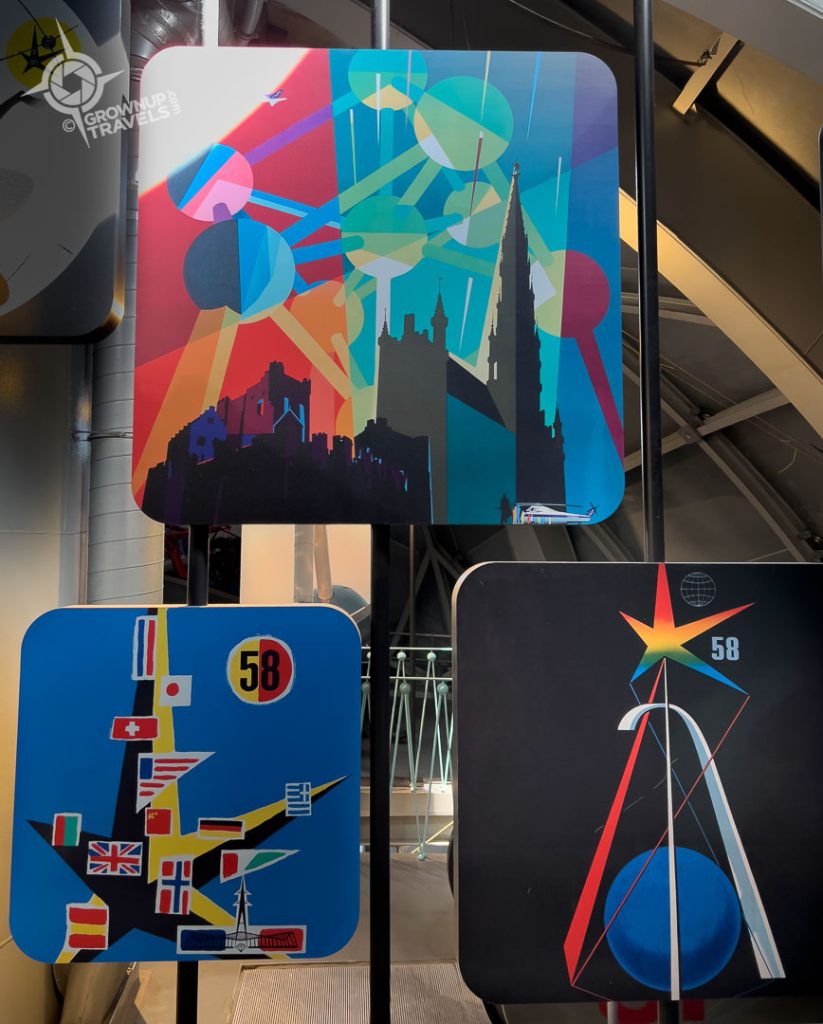
The exhibition includes drawings and architectural sketches from the designers, as well as some fun historical objects, including visitor guides and Expo ’58 hostess items which are always fun to revisit so many decades later. (We did something similar at Montreal’s 50th Anniversary of its own Expo ’67.)

The posters and logo designs used for Expo 58 are on display and are a great example of the late 1950s ‘futuristic’ aesthetic, as well.
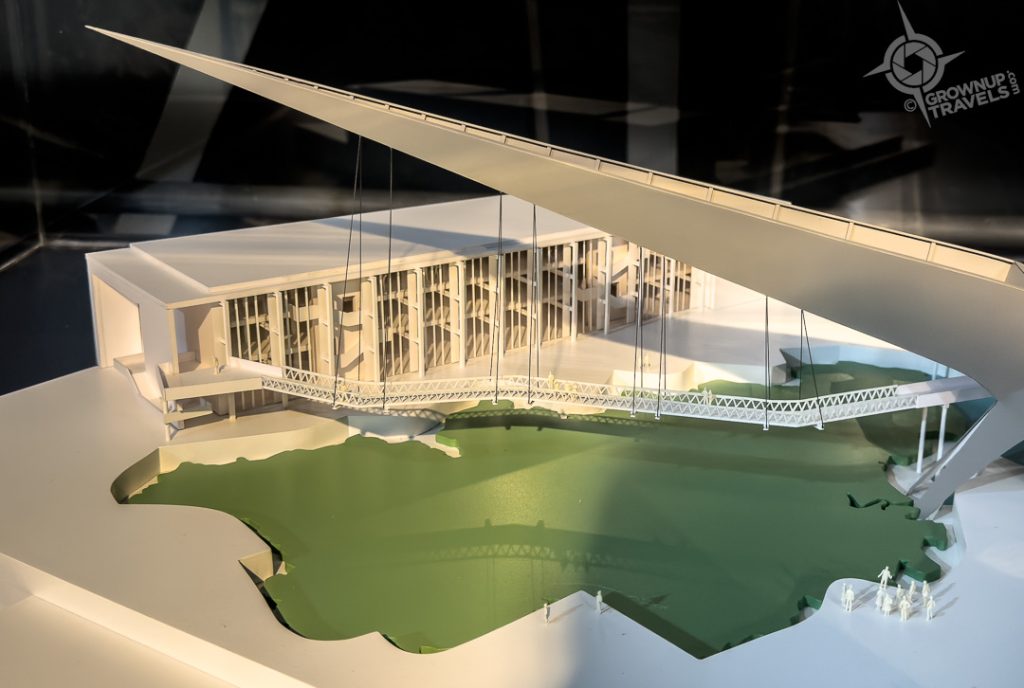
Another addition installed in 2020 is an incredibly detailed miniature replica of the 1958 exhibition grounds including all its 45 international pavilions and the Atomium itself scaled down to size. (not down to its actual atomic size, but accurate nonetheless!) It’s the work of Etienne Tollenaere, a retired model-making enthusiast who visited Expo 58 forty times when he was 12 years old. An amateur artist himself, Tollenaere spent over 1700 hours recreating this miniature version of the Park, right down to the exact number of trees on the grounds.

Immersive Digital Light Installations
Inside the tubes housing the Atomium’s escalators, visitors are treated to an immersive digital light display that will have you feeling like you are in that galaxy far, far away after all.

As you ascend between levels and spheres, multi-coloured, pulsing LED lights surround you, giving you the impression that you are travelling inside a futuristic spacecraft or about to jump into hyperspace. Even if you’re not a space nerd, it’s a very cool visual effect.

The Atomium: an Enduring Icon
The Atomium is a study in contrasts: as the showpiece of Expo 58, it was designed to be a positive symbol of a future where not just technology, but international cooperation would usher in a new age for mankind. On the other hand, it was built during the height of the Cold War, when ideological and economic tensions threatened our very existence with malicious use of that same Atomic Age technology.
Despite this contradiction, the Atomium still stands as a monument to the future – and the possibilities that the future holds. Which may be why this enduring icon from the past still appeals to so many of us in the present.
But even putting aside its philosophical symbolism, the Atomium is unlike any other structure in the world and still manages to wow its 21st century visitors the same way it did those who came here in 1958.
Which is no small thing, and reason enough to visit in my books.

PRACTICAL TIPS FOR VISITING THE ATOMIUM IN BRUSSELS
HOURS: The Atomium is open every day from 10am to 6pm, with the exception of holidays and the occasional scheduled maintenance closures. Be sure to check the website to confirm.
TICKETS: These are available online or at the ticket office with adult prices starting at 16 Euros and discounts offered to seniors over 65, children and other special groups. Combo tickets are also available that include other attractions nearby like Mini-Europe (a park filled with 1/25-scale models of European landmarks and famous sites) and the Planetarium.

ACCESSIBILITY: Although the Atomium is equipped with an elevator and escalators between spheres, a complete tour includes visiting 6 levels with some stairs between (a total of 80 steps up and 167 steps down).

Special thanks to BE CULTURE who arranged a complimentary visit to the Atomium for Henk and I.

Jane is an award-winning travel writer and photographer and an accredited member of the Travel Media Association of Canada (TMAC). In their annual awards competition, TMAC named GrownupTravels.com as the Best Self-Published Travel Blog in 2025 .
She is also a member of the North American Travel Journalists Association, and a freelance travel writer contributing to both print and online publications.





The Atomium truly embodies a harmonious blend of history, science, and architectural brilliance. Your vivid description and stunning photographs make me feel as though I’m standing right there, gazing up at this iconic structure. The detailed backstory of its creation and restoration highlights its importance not just as a monument but as a symbol of optimism and innovation. Thanks for sharing such an inspiring journey through one of Brussels’ most unique landmarks!
Thank you so much for your comment, Anna. It was a real pleasure to visit and I’m glad you enjoyed our article about it!