
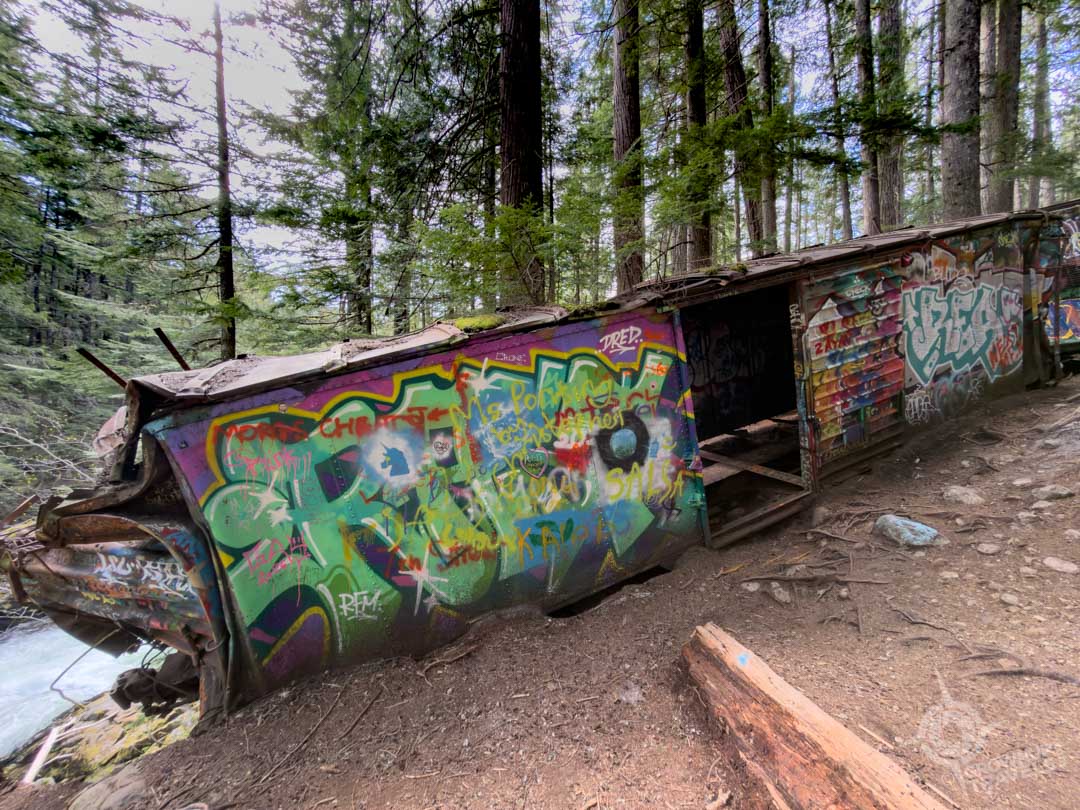
What propelled this boxcar to the brink of the Cheakamus River gorge?
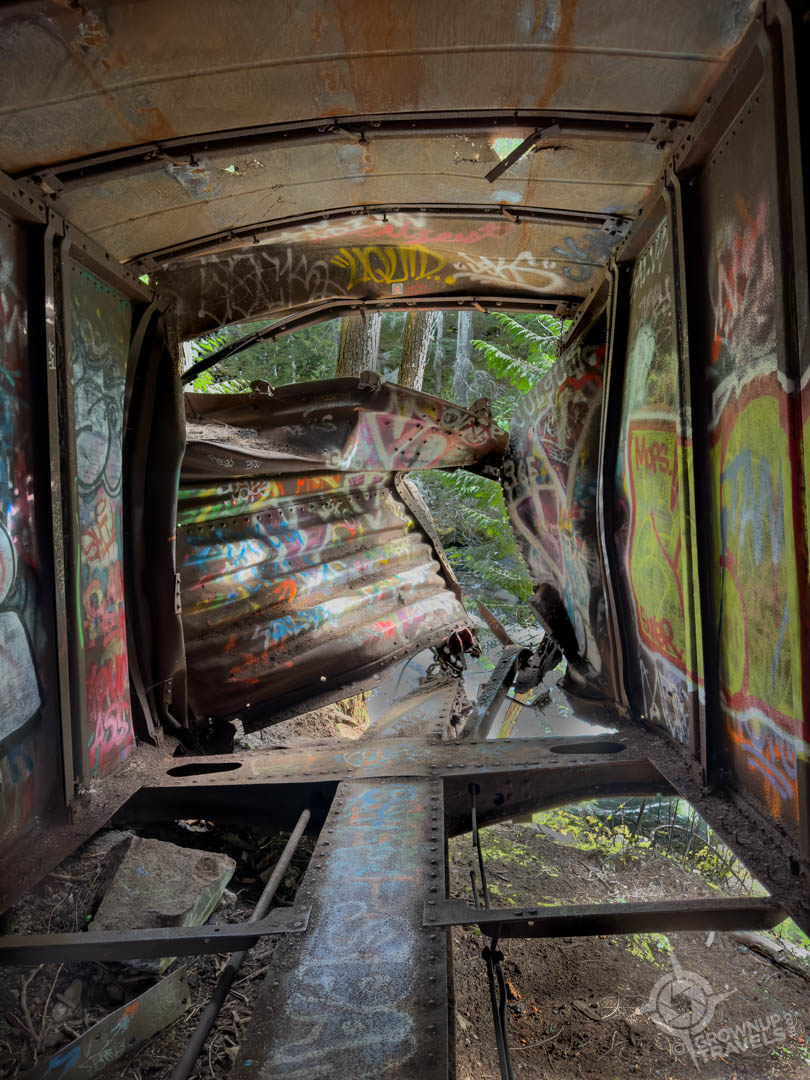
A mangled, graffiti-covered boxcar perches precariously close to the lip of a forest ravine where 30 feet below, the icy waters of the Cheakamus River rage through the gorge. Another wrecked train car lies on its side farther up the trail, an entire panel from its roof peeled back as if it has been pried open by a giant can opener. Farther still, more cars lie between towering cedars and firs, none of which seem to have been damaged by the metal carnage lying adjacent to them. The site begs the question, where did the train cars come from, and how did they end up here, with train tracks nowhere in sight? The answer may not be as mysterious or enigmatic as the train wrecks themselves, but the history and the juxtaposition of street art, metal and beautiful rainforest make this Train Wreck Hike the coolest hike near Whistler, British Columbia.
The Once Off-Limits ‘Train Wreck Hike’
Although it is well known to locals in the town of Whistler, the Train Wreck Hike was always an ‘off-limits’ destination because gaining access to the site meant traversing a still-active railway line adjacent to it. Yet despite that danger – or maybe because of it – intrepid trail runners, photographers, and graffiti artists were drawn to the location because of its strange collection of wrecked boxcars scattered throughout the forest.
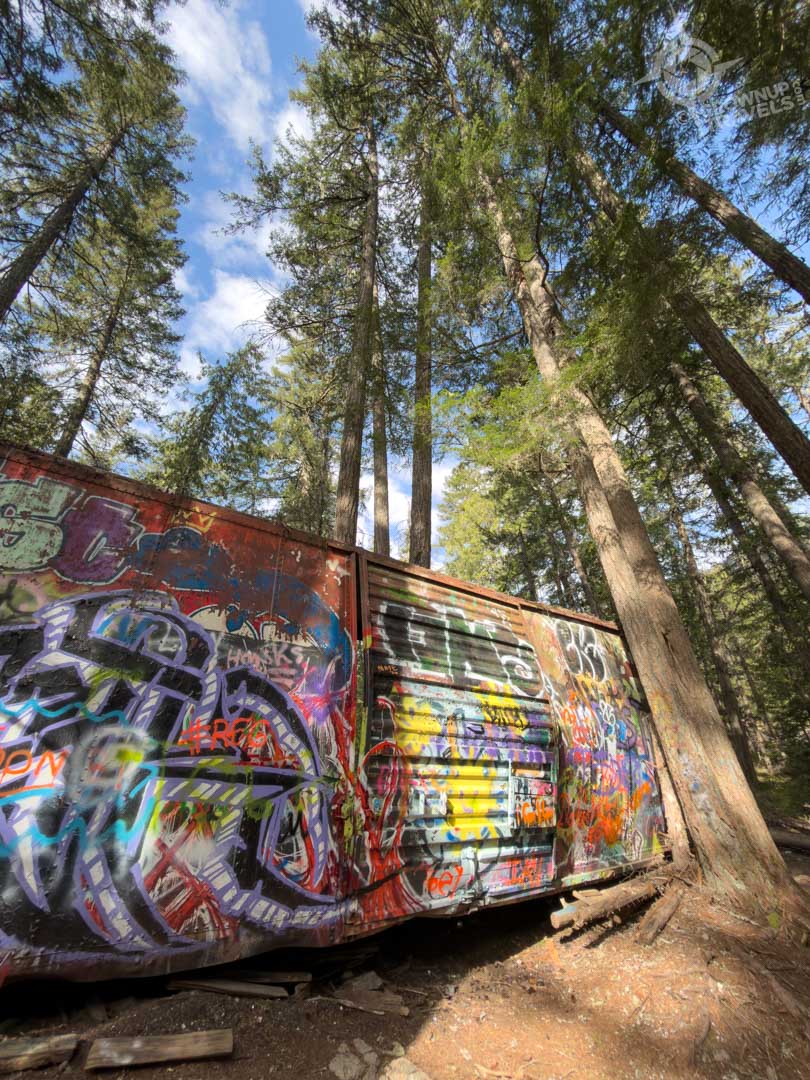
Artists began to use the abandoned cars as metal canvases, and over the years, the seven twisted and overturned boxcars became an unofficial art installation, covered in colourful and ever-changing graffiti and street art. Naturally, this made the site even more interesting, drawing more and more curious locals, visitors and photographers, until in 2016, the local government decided to step in. But rather than imposing fines or cordoning off the site, they decided to build a suspension bridge across the Cheakamus River to provide a safer, legitimate route for curious hikers to access the site and to keep visitors from trespassing onto private railway tracks.
An Easy, Picturesque Trail
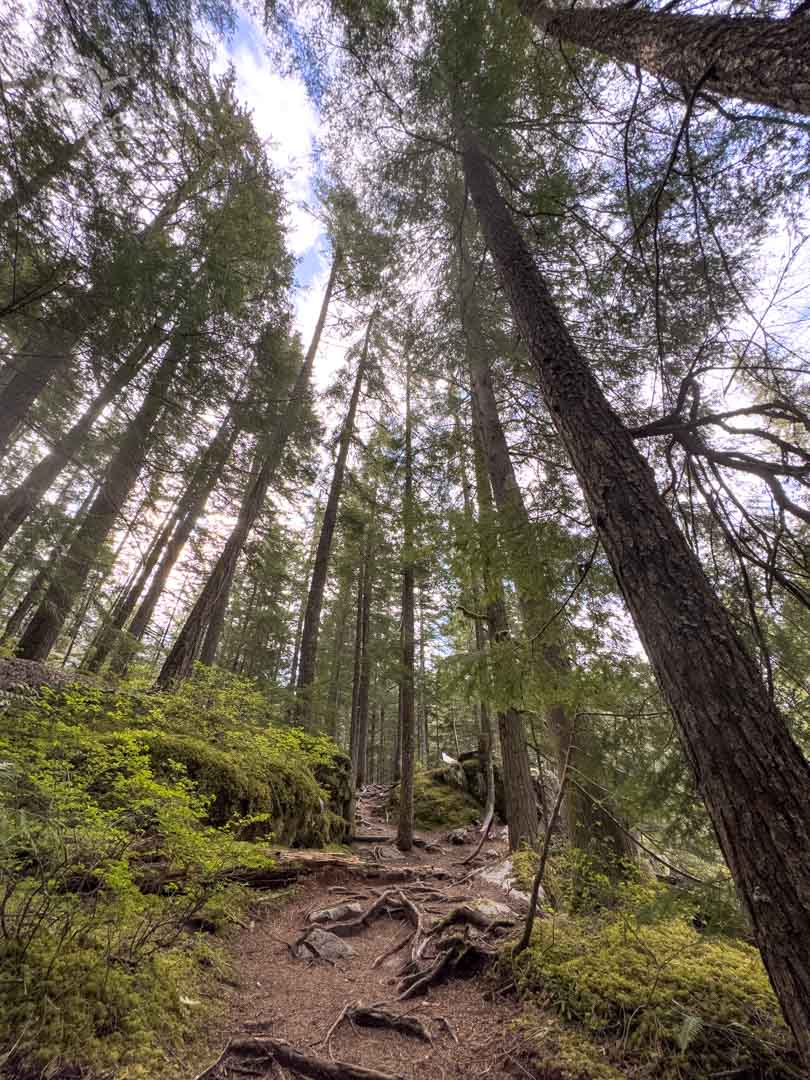
Today, the Train Wreck Hike is a popular one not just because of the colourful, incongruous wrecks at the end of it, but because the trail itself is an easy, scenic one. Plus, a forested canopy keeps the trail cool even in the heat of summer, and although there are plenty of tree roots to deal with, the route is relatively flat before descending to the suspension bridge, about 1 km from the trailhead.
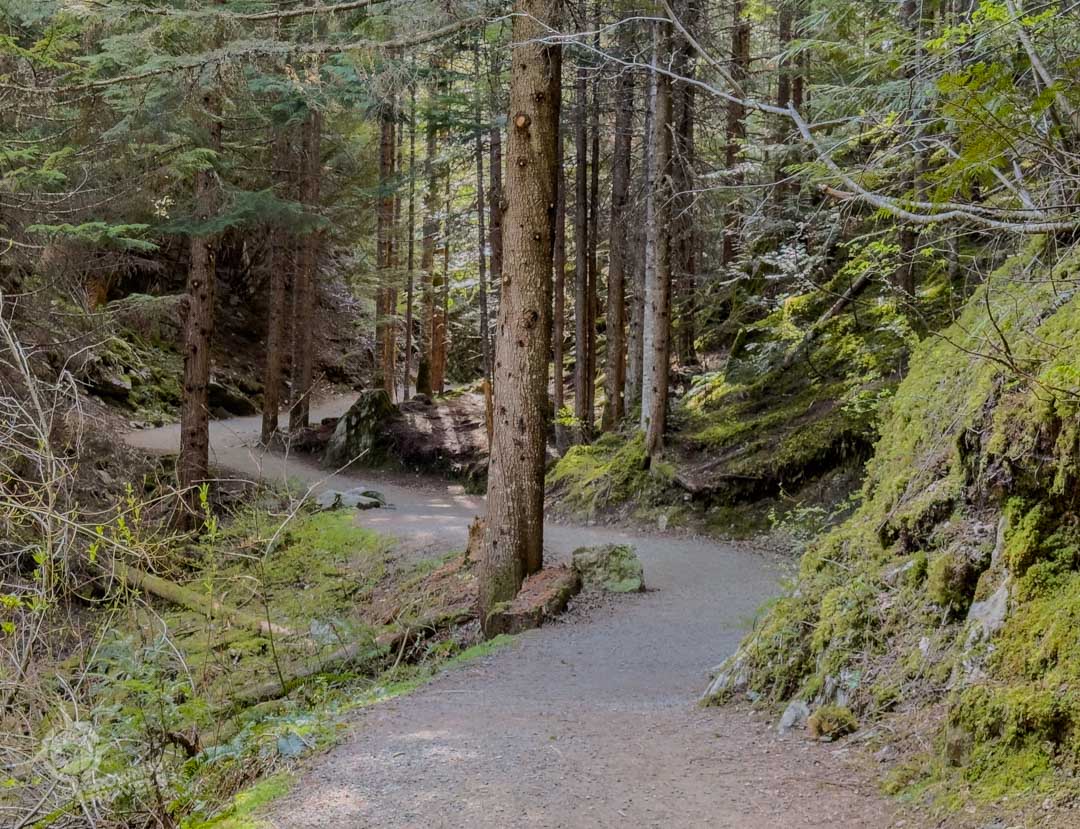
The Train Wreck Trail is a short, easy one for hikers of all ages
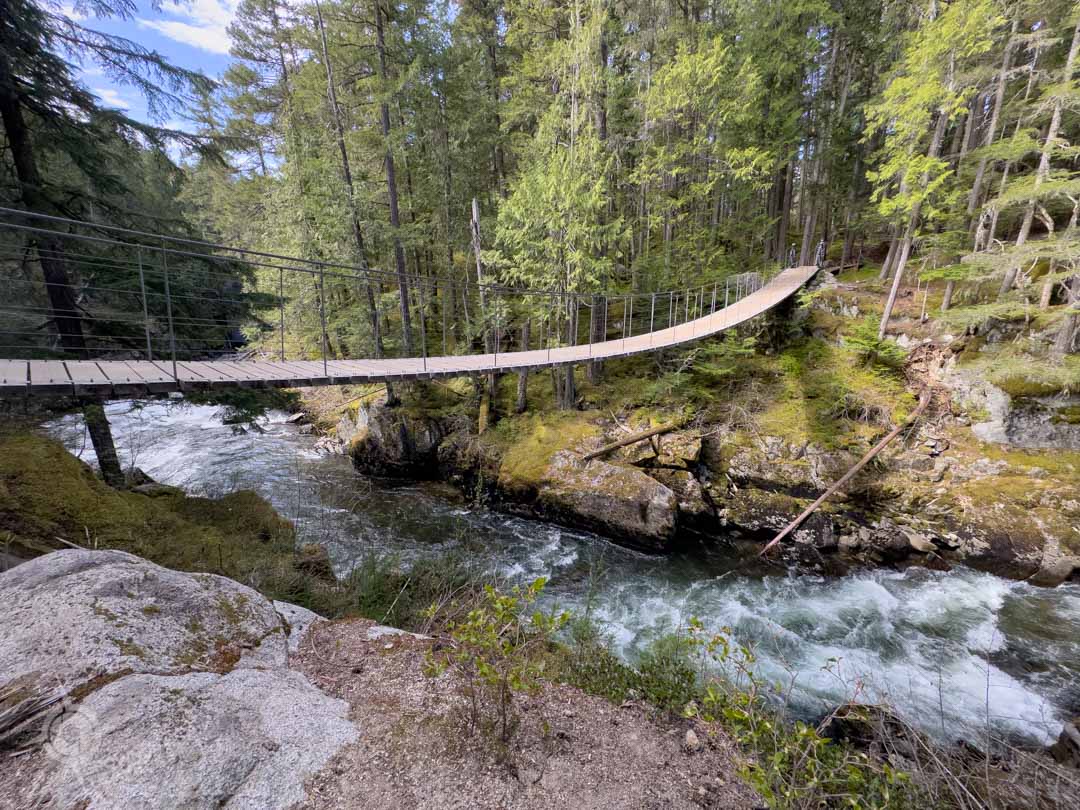
The suspension bridge itself is not just functional, it is now an additional highlight of the trail. Built by a Vancouver engineering firm, there is something reminiscent of train tracks in the narrowness of the bridge design, and the cable supports at either end look like they could be part of a train as well.
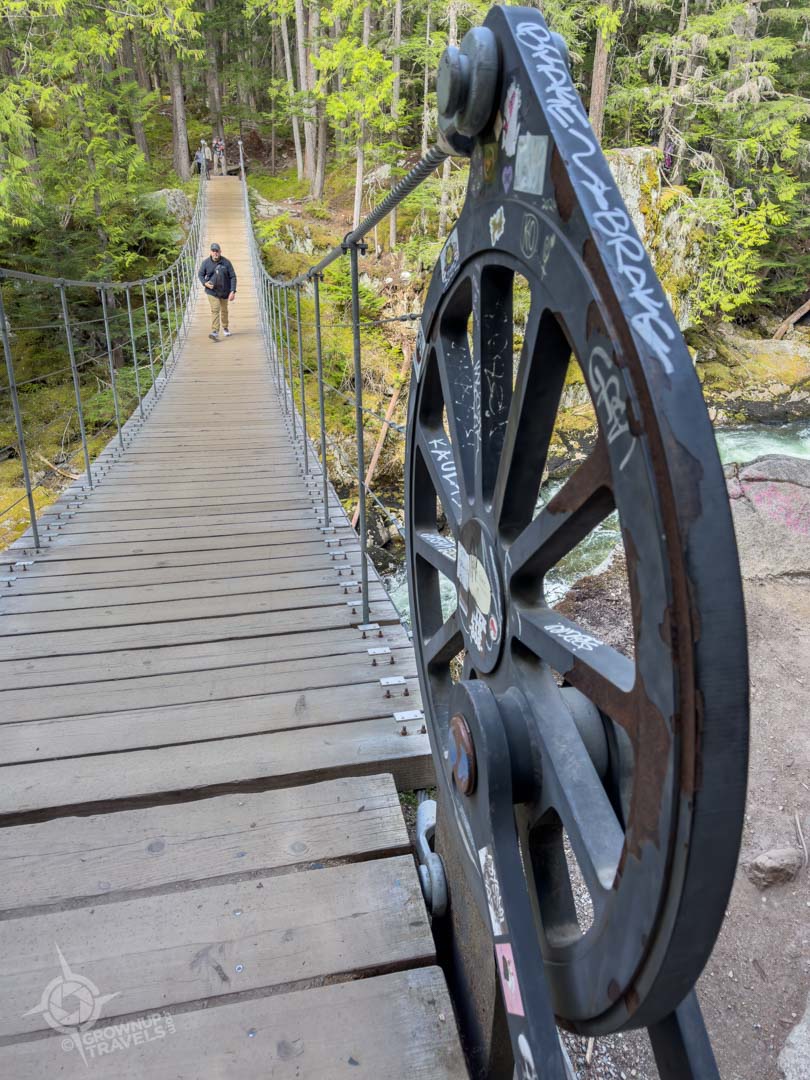
The cable wheels look like train components
Whether these railway-inspired details were intentional or by accident, the bridge itself is discreet and doesn’t detract from the beautiful gorge with the Cheakamus River racing through it. With almost no one on the trail the day that we visited, and plenty of time to enjoy the views, it felt like a more intimate version of the Capilano Suspension Bridge near Vancouver, and we took advantage of the bridge’s viewpoint to admire the river and the gorge.
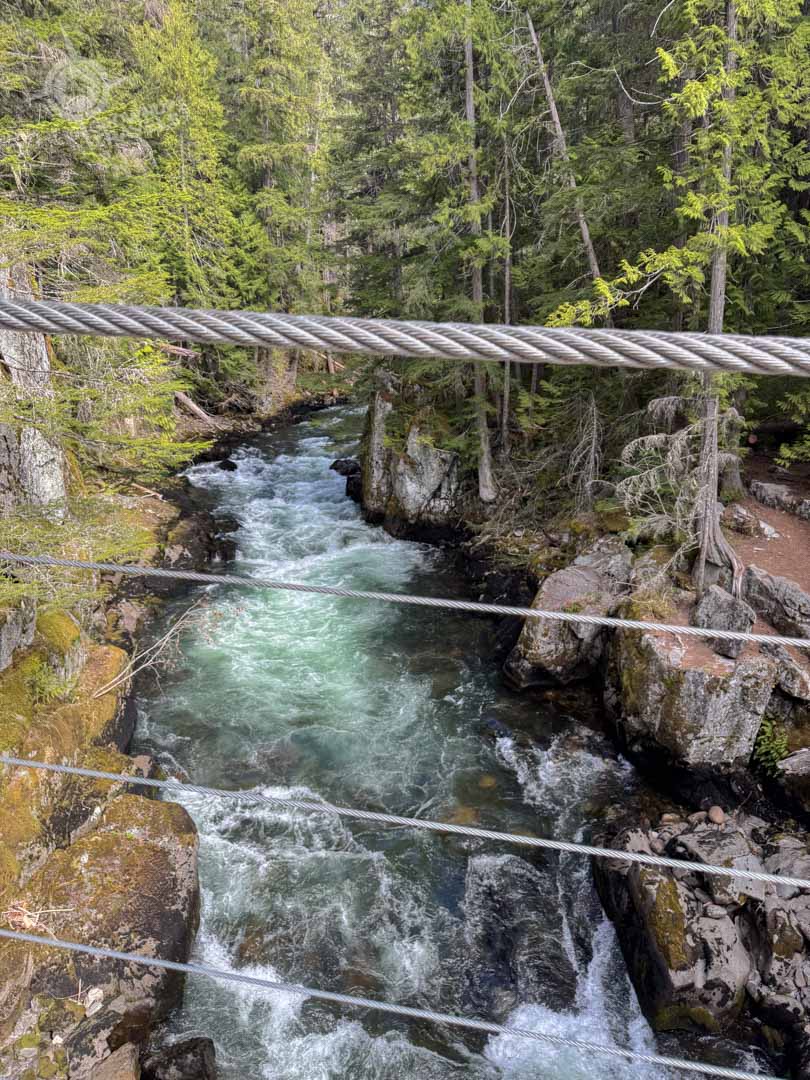
Once across the bridge, the trail continues a short distance to the right before passing literally through the first train car that lies closest to the edge of the canyon. At first glance, the boxcar’s position looks ominous and my imagination ran wild, picturing the car skidding through the forest, tearing up the ground before finally coming to rest just a few feet from the edge of the gorge.
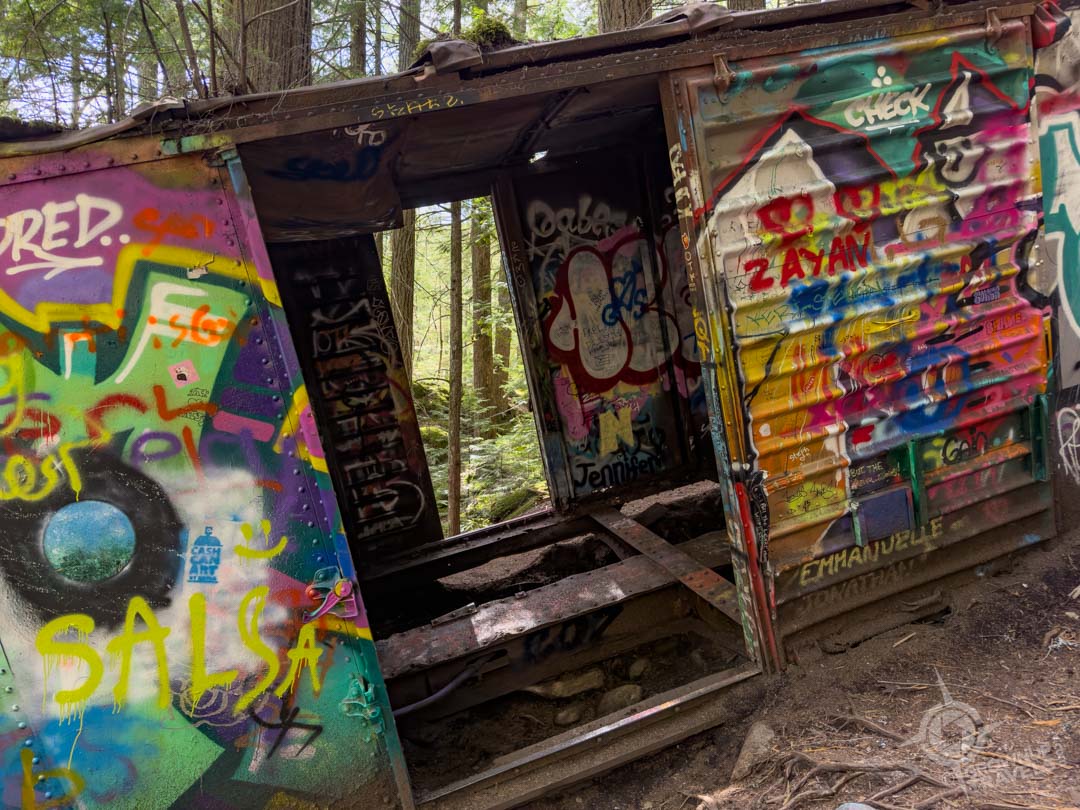
The trail takes you right through a wrecked boxcar
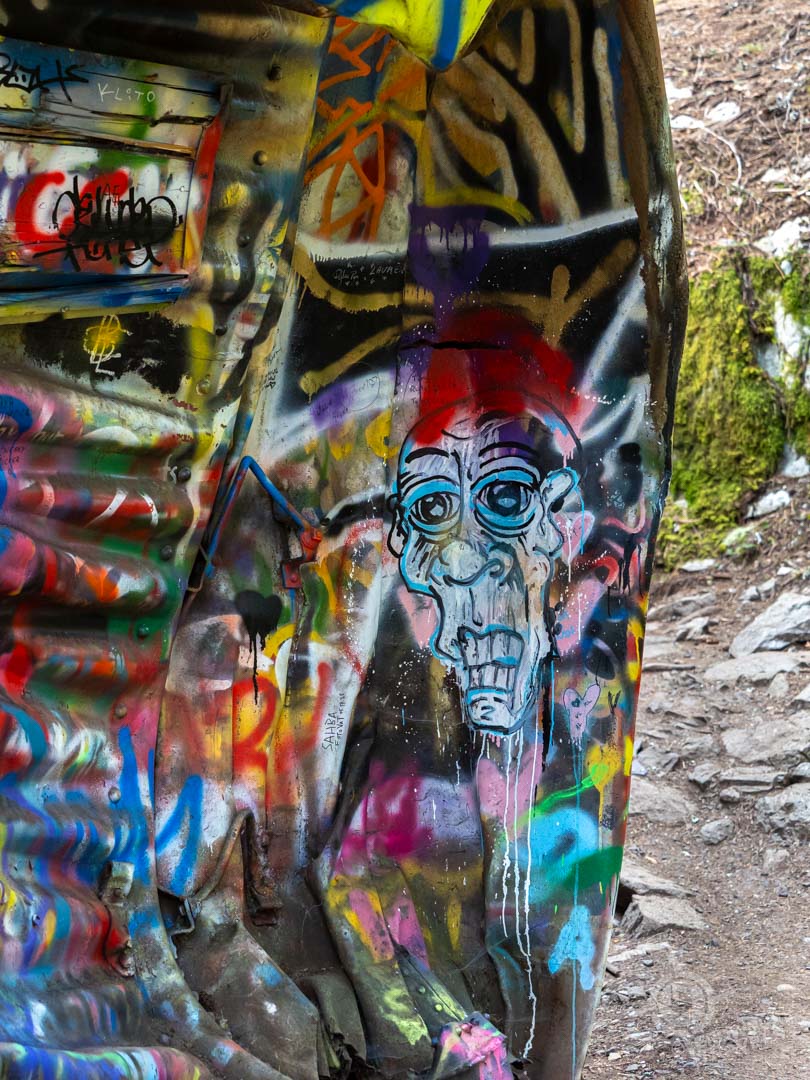
My curiosity was piqued even further, as we saw more cars higher up the slope, some on their sides, some upright, but all completely covered in colourful graffiti. Many bore initials painted by previous visitors, some freshly added only days before our arrival. Other cars had graphics on them that were more figurative, whereas some of the wrecks were just decorated in layer after layer of paint in every colour of the spectrum, becoming abstract art pieces in the process. Set against a background of green forest, it was a photographer’s dream location.
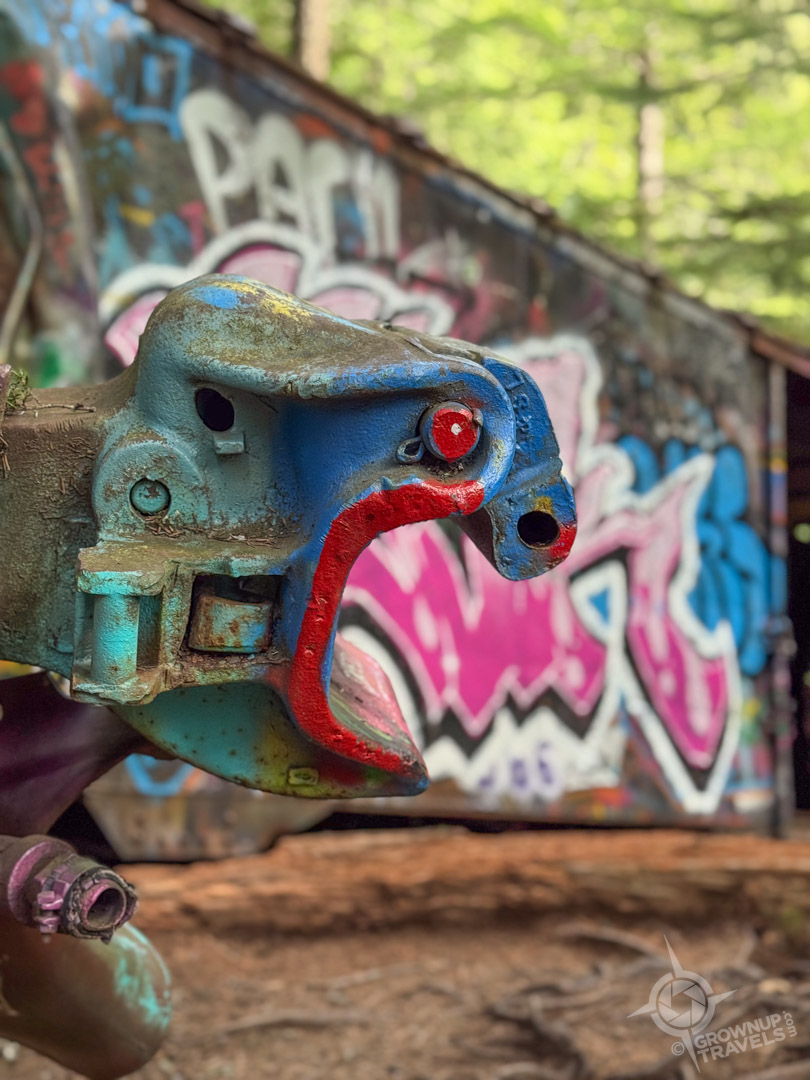
Do you see the face? One artist did.
A Grownup Playground
Just like when the trail was off-limits, visitors to the train wreck site do so at their own risk, and there are no rules stating that you can’t climb onto the boxcars, or go inside of them. And while I’m not one for condoning dangerous behaviour, the kid in me couldn’t resist climbing on top of one of the boxcars (after testing the integrity of the metal ladder first, of course!) Clowning around on top of these ruined cars, I felt a little like a stunt actor in an old western where the hero and the villain chase each other on top of a moving train. Thankfully, these cars weren’t going anywhere.
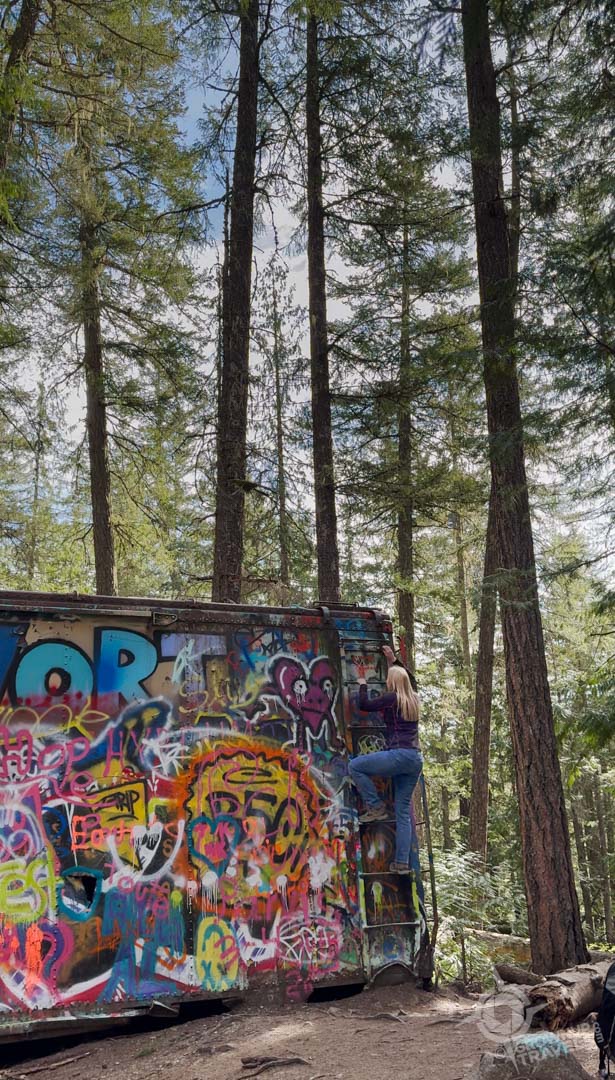
Jane is never too grownup to play!
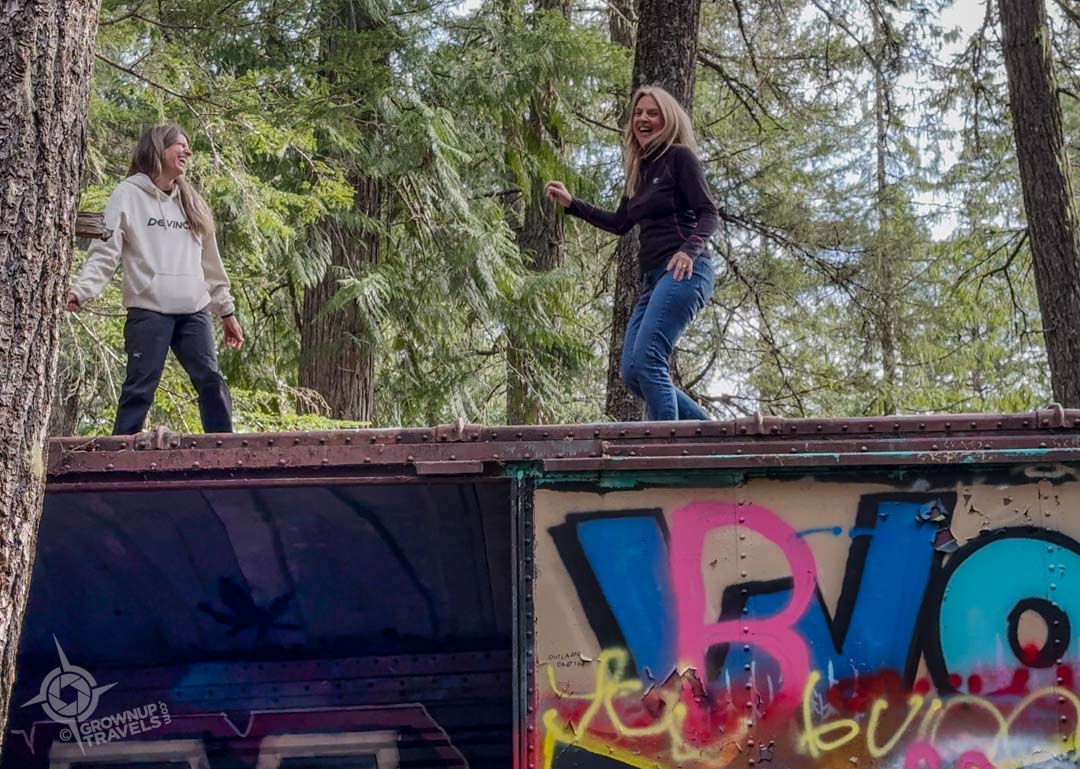
But speaking of going, where were the train tracks?
A short distance farther up the slope gave me my answer: hidden eight feet or so below a ridge was a stretch of track, winding its way through a narrow rock cut and curving around a sharp bend out of sight. But rather than answer any questions, the location of the tracks made me even more puzzled as to how these train cars could have ‘jumped’ such a height and ended up nowhere near the tracks themselves. Just how fast was this train going!?
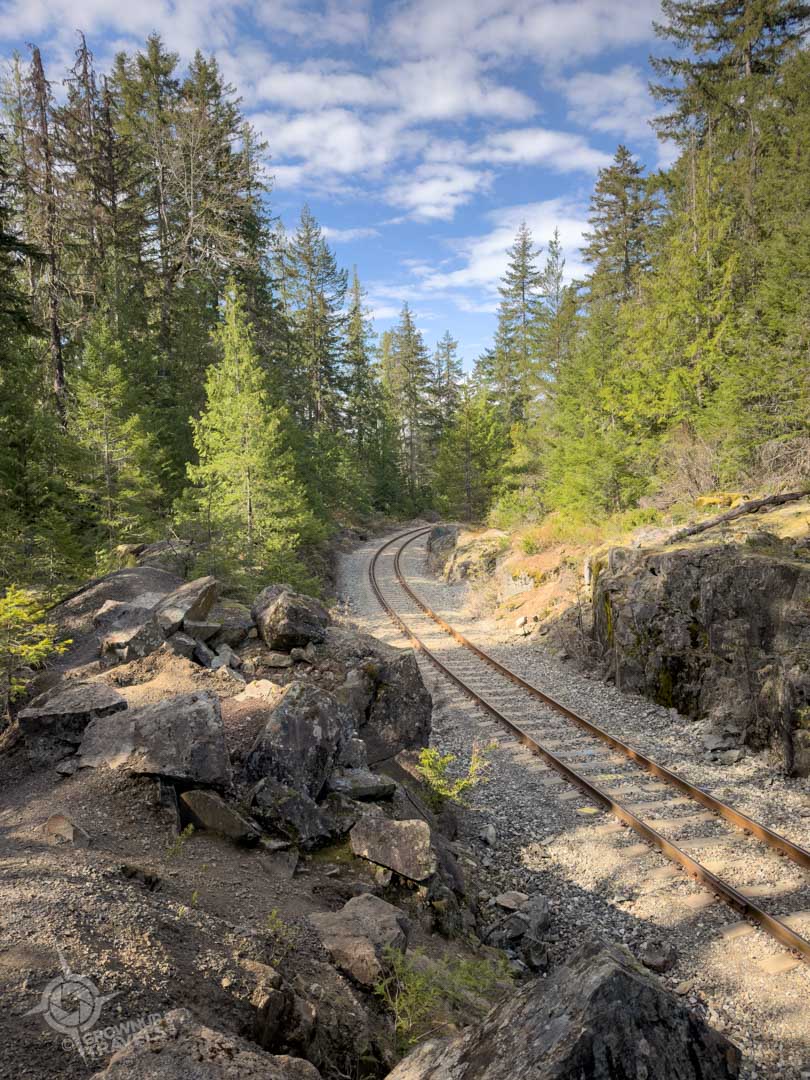
The tracks are nowhere close to the wrecked boxcars…
A historic plaque on the site told some of the story of the wreck, but there was more to it, the details of which were provided by eye witnesses to the aftermath.
How? Why? When?
It was August 11, 1956, and an overloaded freight train carrying lumber was travelling towards Vancouver via Parkhurst, near Whistler, British Columbia. There had been a mistake made with the tonnage of the cargo, and the four engines powering it were struggling to stay on schedule hauling the heavy load. So the crew split the train to lighten the load, and the engineer made a fateful decision in an effort to make up for lost time: he sped up. Pushing the engine to more than double the recommended speed, the engineer underestimated the momentum of the train as it barrelled through a narrow rock cut heading towards a sharp curve at the end. Travelling at more than 58 km/h (35 mph) the inevitable happened: the engine jumped the rails on the curve, taking the twelve boxcars loaded with lumber with it, damaging many of the cars and wedging three into the narrow pass, completely blocking the route.
Righting or moving the damaged boxcars off the track in the tight space proved to be near-impossible for the railway, and this being the only route to move people and supplies through the mountains, time was of the essence to clear the track. After days of delays, the railway reached out to a local logging company run by the Valleau family, to ask for their help. Using their heavy equipment, the Valleau workers helped move the least damaged cars out of the pass so they could be transported away from the crash site.
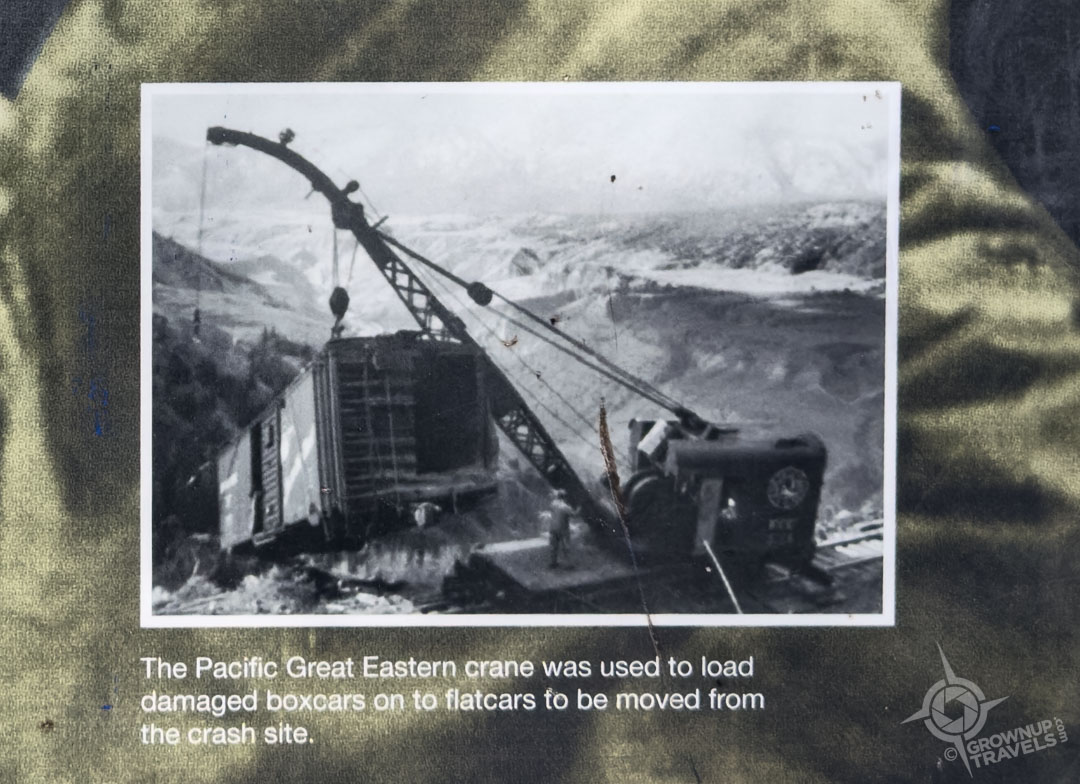
This detail from a historical plaque on site shows the recovered cars being loaded onto flatbeds
As for the heavily damaged boxcars, they were stripped of anything salvageable and their carcasses were dragged farther up the track, hoisted out of the way and left on what was a logged-out forest slope adjacent to the train tracks. (This solved the mystery of why the trees didn’t appear damaged: the trees you see today had actually grown up around the cars in the last 70 years.)
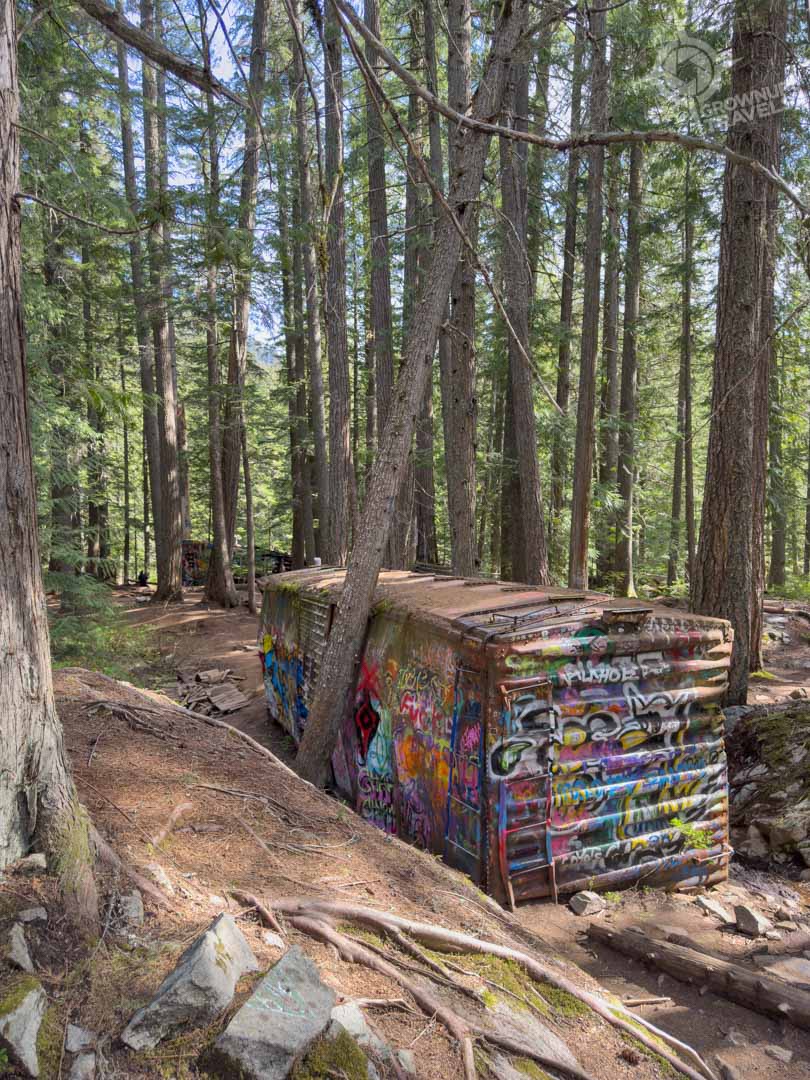
The wrecked cars were abandoned and in the decades after the accident, a forest grew around them
The event cost the engineer and his crew their jobs, but fortunately, no one lost their lives. And although they would never have imagined it, the legacy of their mistake has become a site where the unexpected combination of rusted metal, nature and art is now a popular, if unusual, tourist attraction.
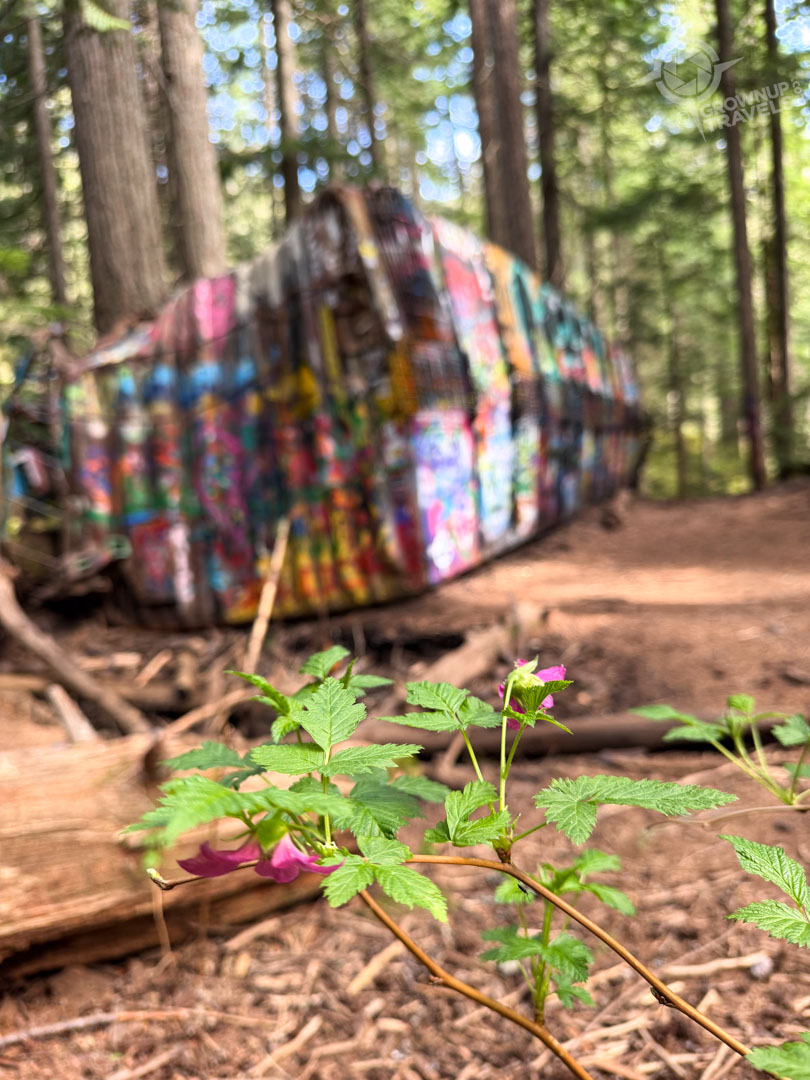
Metal, art and nature coexist here
The Coolest Hike Near Whistler
Being an ‘occasional hiker’, I am definitely more about the destination than the exercise: is there a cool waterfall, an amazing viewpoint, an interesting rock formation or scenic cave at the end of the trail? Features like these are what help me choose one hike over another. So naturally when Henk and I went to Whistler, we expected there would be no problem finding a mountain trail that would deliver on any or all of these natural wonders. What we did not expect was to find an al fresco art installation of half a dozen boxcars covered in graffiti nestled in a beautiful rainforest, all the result of a decision made over 70 years ago by reckless train engineers who were running behind schedule.
While there may be more beautiful and awe-inspiring nature trails in the mountains here, nowhere else will you find something as unique as this interactive boxcar graveyard/museum/art gallery, which is reason enough for me to recommend the Train Wreck Hike as the coolest hike near Whistler, British Columbia.
PRACTICAL INFO FOR THE TRAIN WRECK TRAIL
LOCATION: The Train Wreck Trail is just south of the town of Whistler, British Columbia, off of Jane Lakes Road where there are designated travel parking lots. The trail map can be found on the Trailhead sign for Sea to Sky/Train Wreck Trail. There are more details here on the Vancouver Trails website if you are hiking the trail on your own and want to get details about the terrain, length of trail, etc before you go. Note that there are no toilets on this trail.
GUIDED HIKE: If you are staying at the Fairmont Chateau Whistler in the town of Whistler, your resort fee at the hotel actually includes many complimentary activities which you can book through the front desk. One of these is a guided hike to the Train Wreck Trail where guests are taken to the trailhead by van and accompanied on the hike by one of the trained guides hired by the hotel.
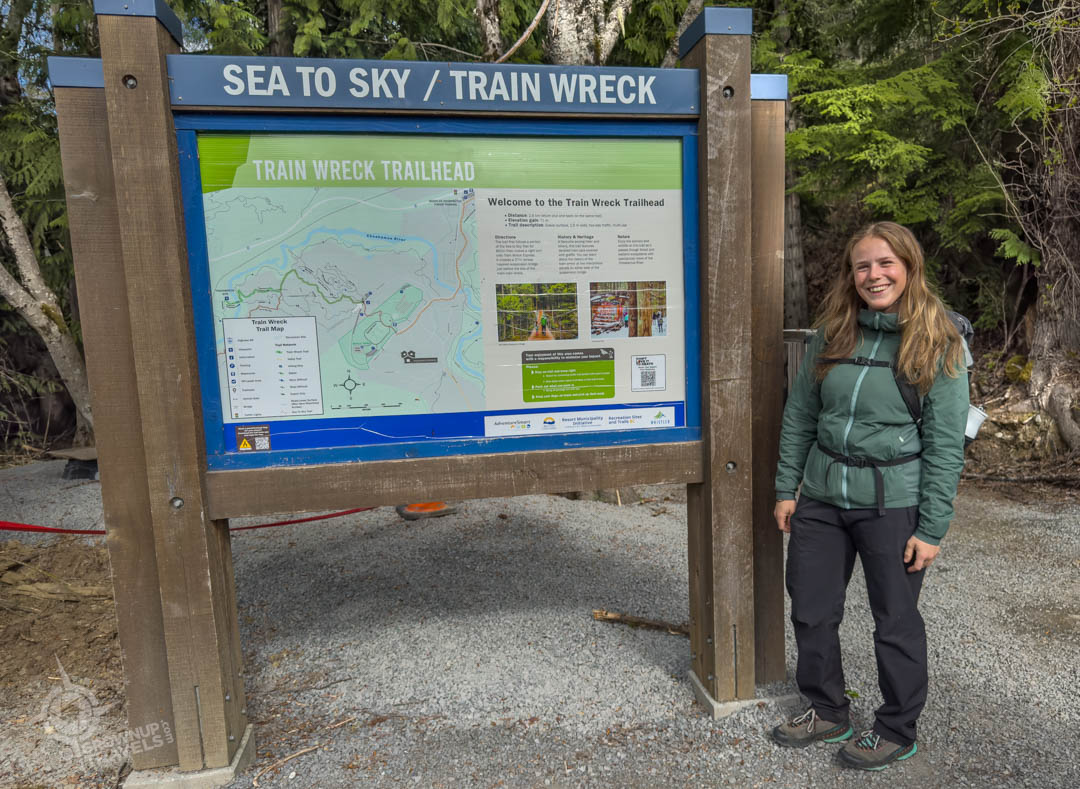
The Fairmont Chateau Whistler offers free guided hikes to their guests, one of which is the Train Wreck Trail. Our guide (above) was lovely!
Special thanks to Tourism Whistler who hosted Henk and I as part of a group press trip, and to the Chateau Fairmont Whistler where we stayed.

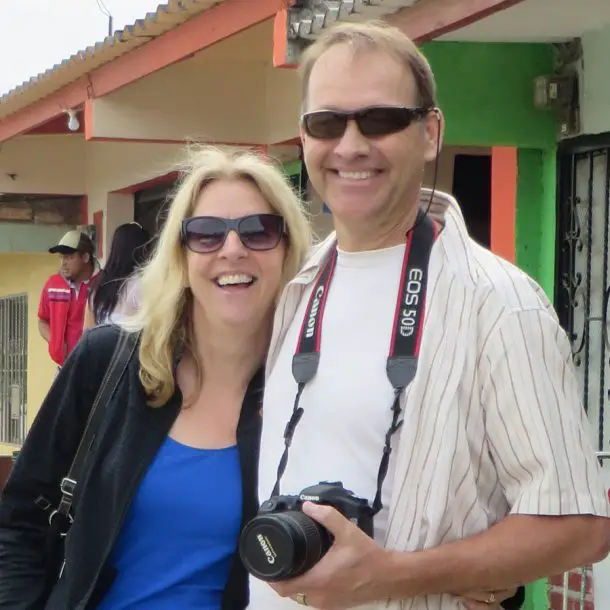
Jane is an award-winning travel writer and photographer and an accredited member of the Travel Media Association of Canada (TMAC). In their annual awards competition, TMAC named GrownupTravels.com as the Best Self-Published Travel Blog in 2025 .
She is also a member of the North American Travel Journalists Association, and a freelance travel writer contributing to both print and online publications.




Subscribe and you'll never miss an update!
Join our mailing list to receive the latest news and updates from Grownup Travels. (We keep your email STRICTLY private)
Thank you for subscribing to Grownup Travels!