
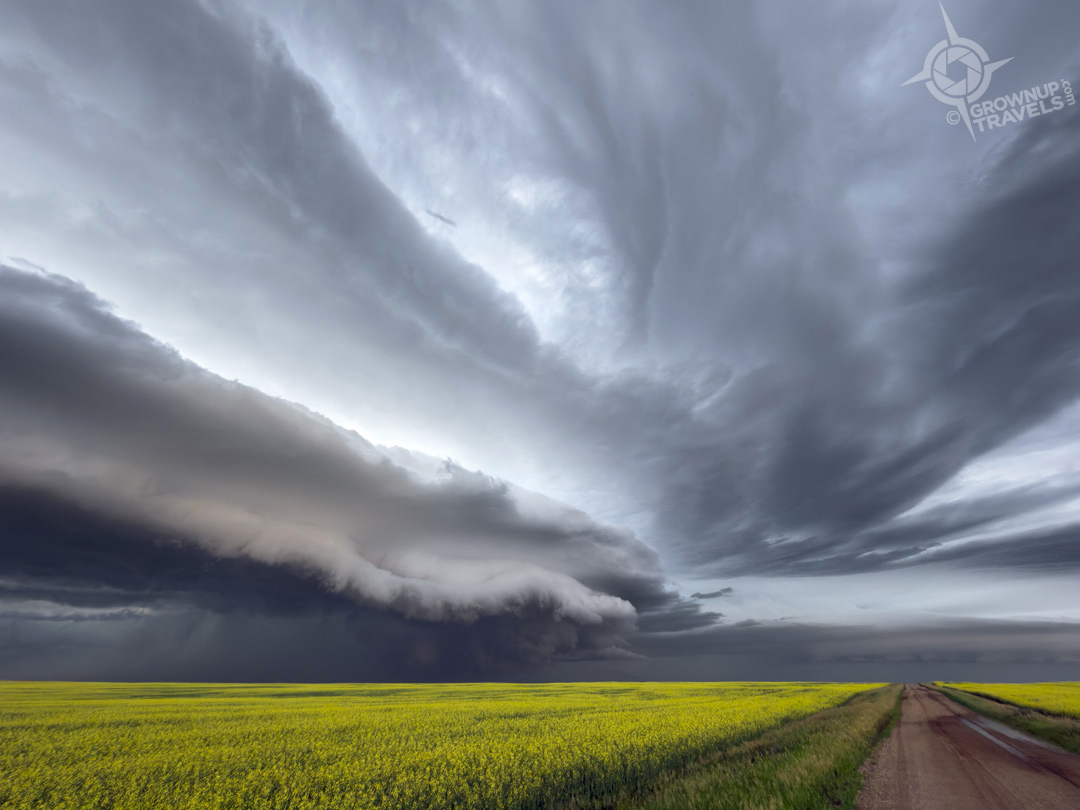
We were punching the core of a line of intense thunderstorms, barrelling along a dirt road at breakneck speed with what felt like marbles under the wheels. The phone rings from a fellow storm chaser following a few kilometres behind us: ‘I’ve blown a tire and it looks pretty bad”.
I could see the hesitation cross our driver Scott’s face, given what he had just been through. “Punching the core” is storm-chaser lingo for doing what they try to never do: drive right through the centre of a massive storm cell. But Scott’s hesitation lasted for only a moment, because no one is going to leave someone in a bind under the kind of storm we had just battled through. So we turned around and headed back into the thick of it.
A storm chasing tour in Saskatchewan is not for the faint of heart. (Nor the faint of tires, apparently.) But if my 4-day ridealong with two storm chasers in Saskatchewan had taught me anything, it was that safety is paramount when it comes to dancing this particular dance with Mother Nature. Consulting an array of radar models and weather data that he is constantly monitoring, Scott knew that our rescue mission may mean getting a little wet, but our path back into the storm was not life-threatening. Stressful, yes, with roads barely visible despite wipers in manic mode, but luck was with both us and the hobbled storm chaser this time: after some help changing his destroyed tire, our storm chasing colleague was able to get back on the road and limp his way home to Regina.
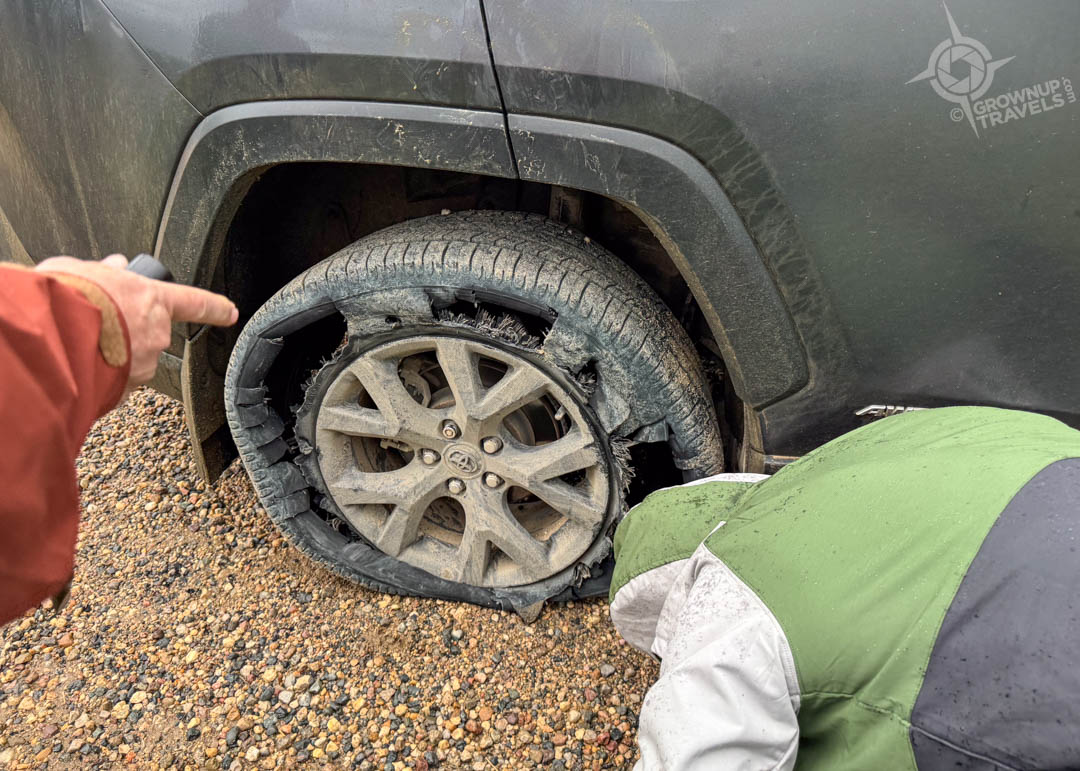
A blown tire meant the end of the day for one storm chaser
Storm Chasing in Saskatchewan for Sport
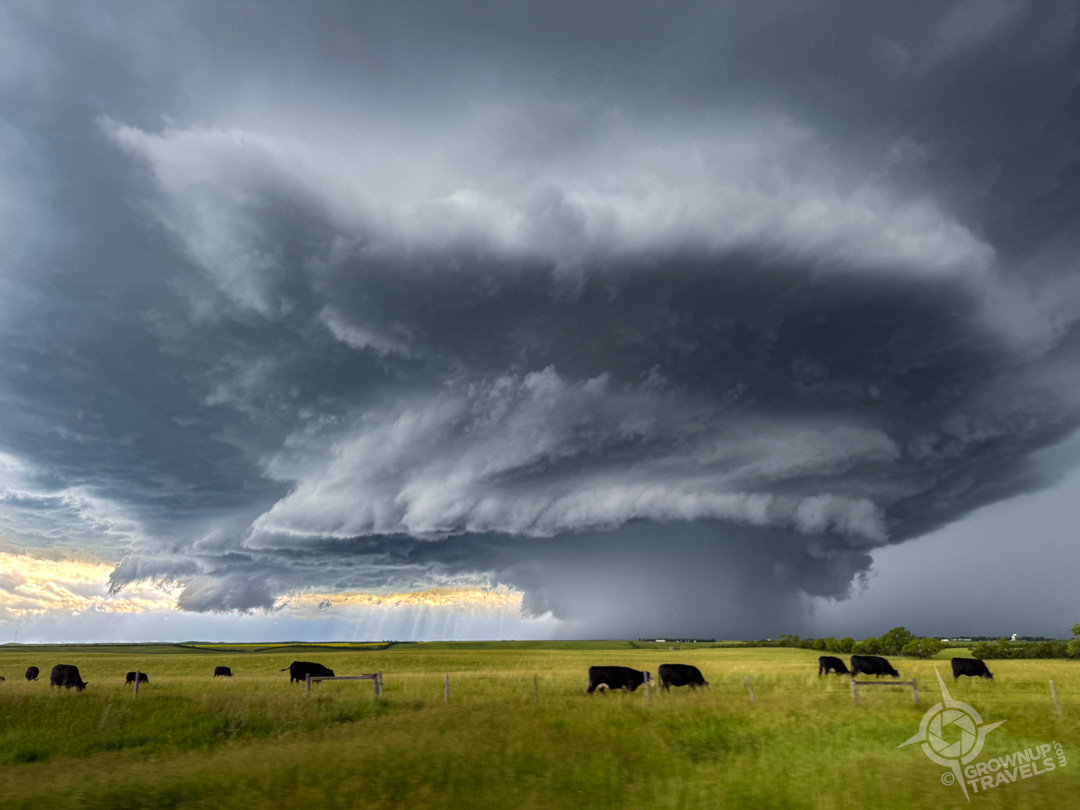
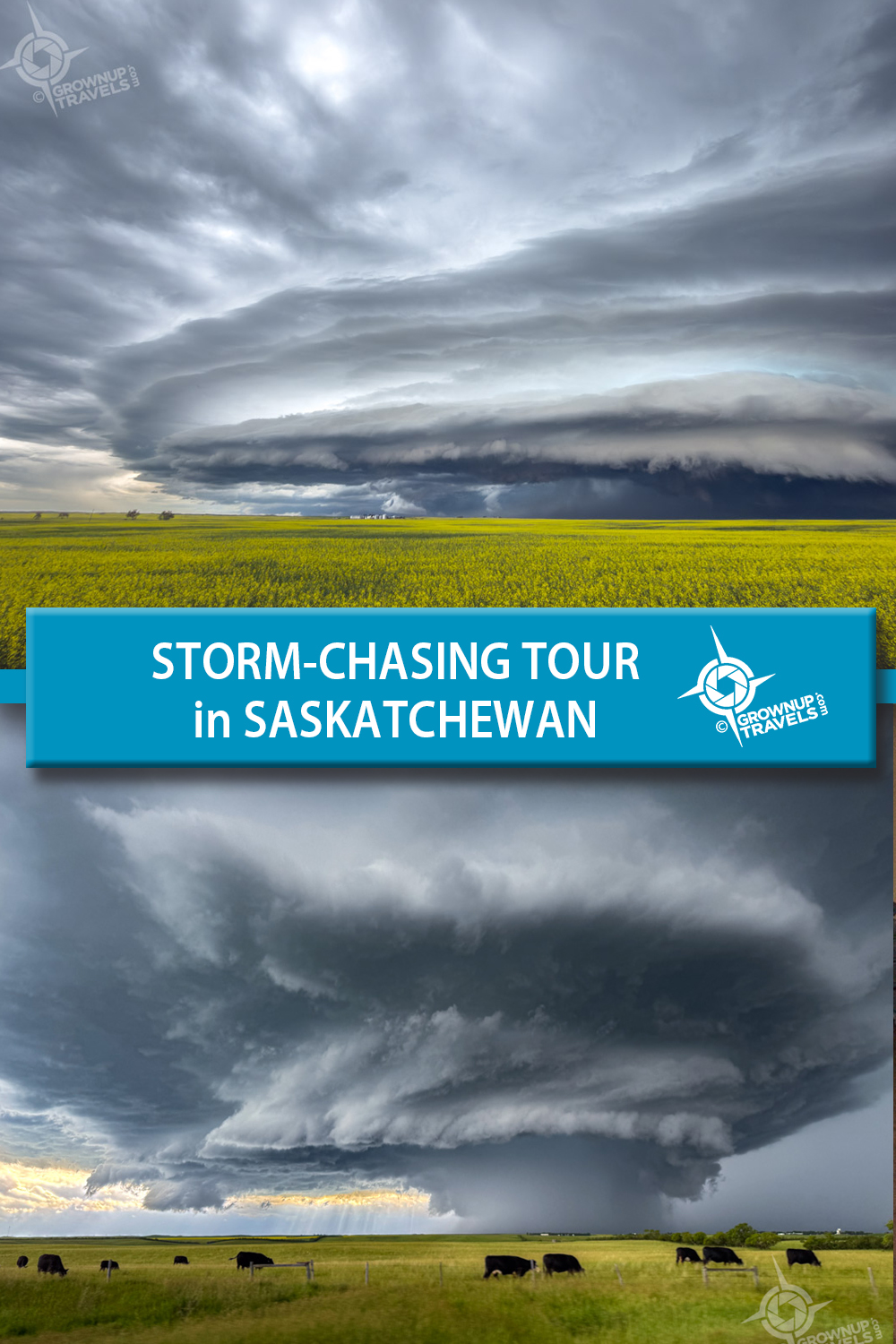
I’m no adrenaline junkie. You’ll never see me sky diving; there’s no amount of peer pressure that will entice me to bungee jump; and base jumping? – it’s just not going to happen. Ever. But when I was offered the opportunity to go on a storm-chasing photography tour in Saskatchewan, this was one adventure I did jump at. It wasn’t because of any desire to see a tornado, or to fuel an adrenaline rush; no, I was excited by the opportunity to see a giant, structured supercell of a thunderstorm over a vast landscape that was free of buildings, trees, streetlights, and other urban clutter. I wanted to capture an image of a storm whose sheer size and dominance made me exclaim ‘Wow!’
What I learned is that there’s no better place for that wow than in southern Saskatchewan, and no better way to capture that feeling than with Living Sky Tours.
Living Sky Tours
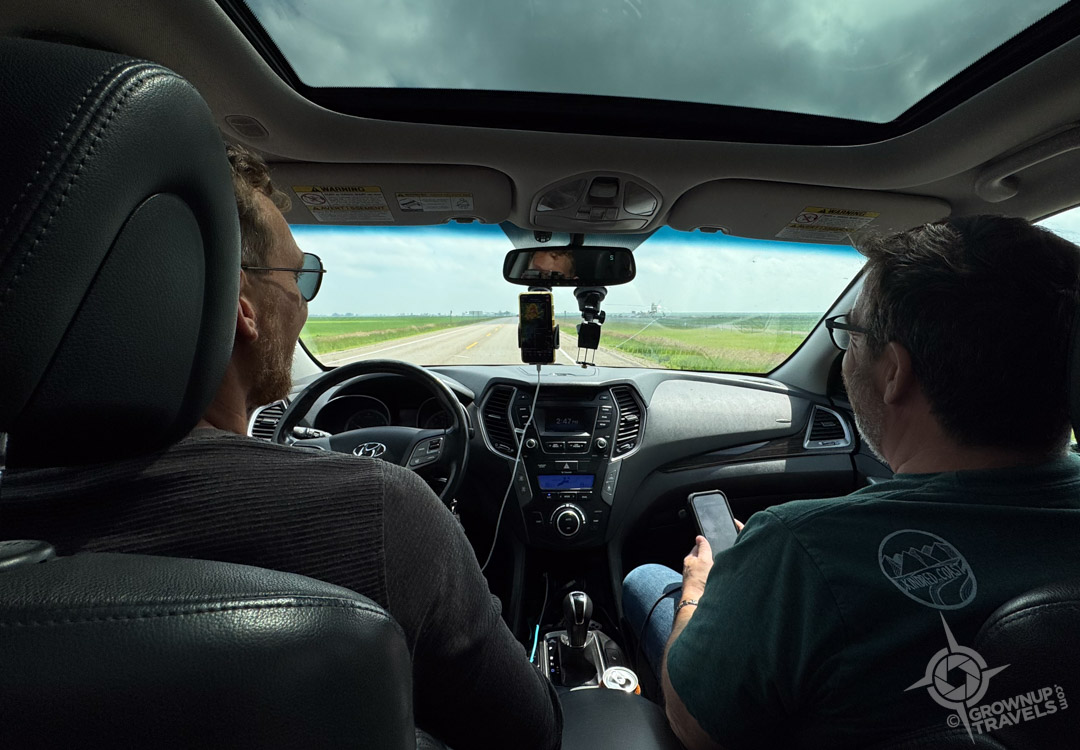
Scott Aspinall and Craig Hilts are partners in Living Sky Tours
Scott Aspinall and Craig Hilts are the partner-operators of Living Sky Tours, a company based in Saskatchewan that specializes in private and small-group photography tours. Their goal is to help their guests capture what makes Saskatchewan so uniquely beautiful: vast landscapes with character-filled grain elevators, some of the darkest skies in the world where the milky way and aurora borealis extend to the horizon, and of course, awe-inspiring stormy skies. Because although both Craig and Scott are accomplished photographers first and foremost, their passion for storms in particular is clear from the moment they start talking about them.
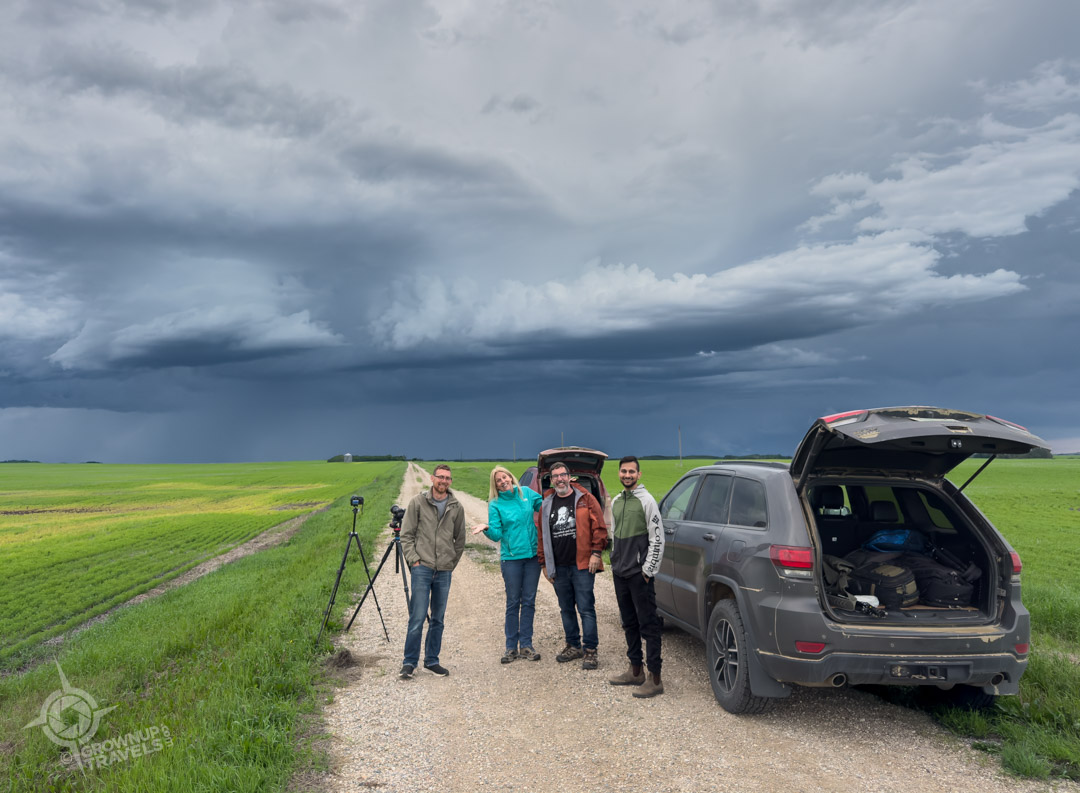
Scott Aspinall, Jane, Craig Hilts and local storm chaser Herry Himanshu
Let’s Talk About Storms
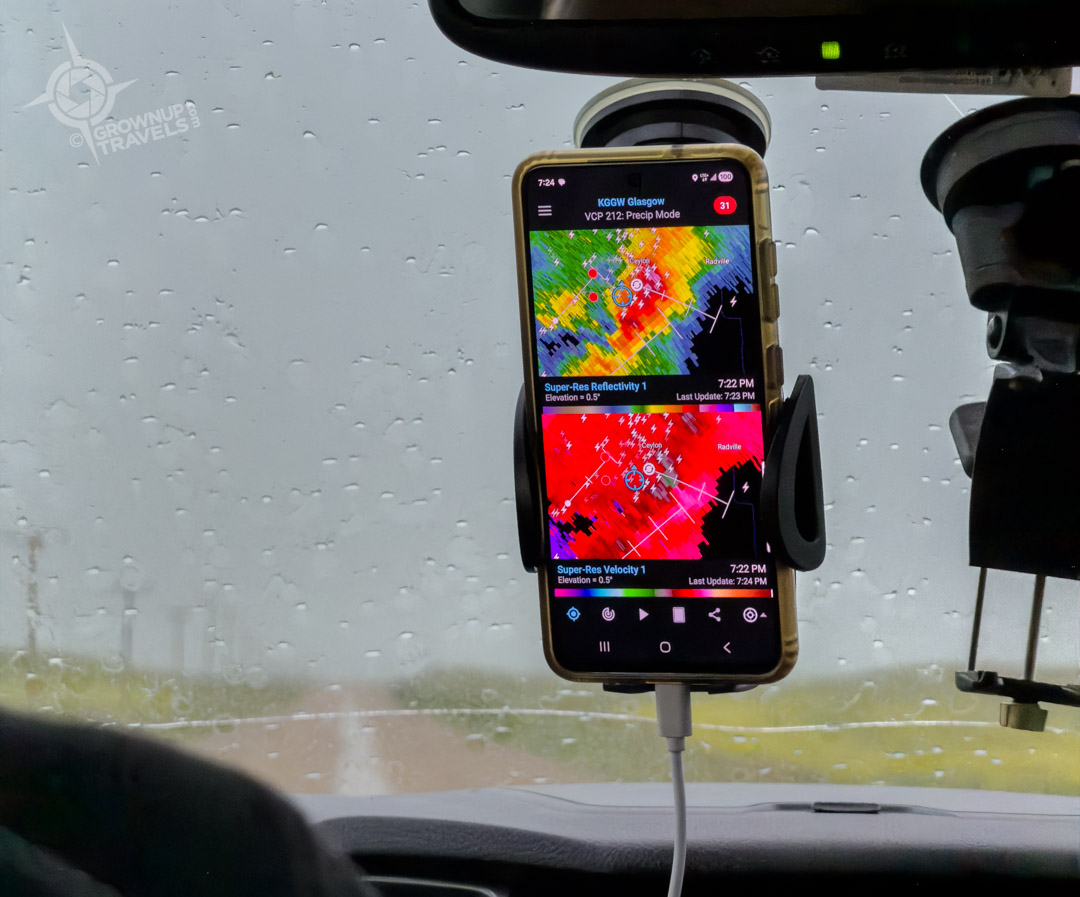
What I soon learned after a detailed orientation presentation from Craig was that serious storm chasers take their storms – well, seriously. As I was walked through the physical anatomy of a supercell storm, the variables that can transform an ordinary thunderstorm into one capable of producing tornados, and the data that goes into predicting storms and their paths, one thing was clear: to be a successful storm chaser/photographer means becoming a de facto meteorologist. For days before and during the actual chases, both Craig and Scott are constantly monitoring multiple websites, tracking radar, wind speed, moisture levels, ground temperatures and eye-witness reports. And most importantly, escape routes.
Why Saskatchewan is Built For Storm Chasing
Data analysis aside, Mother Nature often exercises her woman’s prerogative to change her mind – or in the case of storms, her direction. Which is why the most important factor to consider when chasing storms is the potential danger that one could catch you. There needs to be an escape route or ideally more than one, should a storm decide to ‘blow up’ unexpectedly or take a dramatic turn in an unpredictable direction. A good storm chaser does not want to be caught in the centre of a ‘hail core’, or worse yet, in the ‘Bear’s Cage’ (the blinding wall surrounding a rain-wrapped tornado). In fact, an ideal chase day means returning home with a dusty car, not a rain-hammered, hail-battered one.
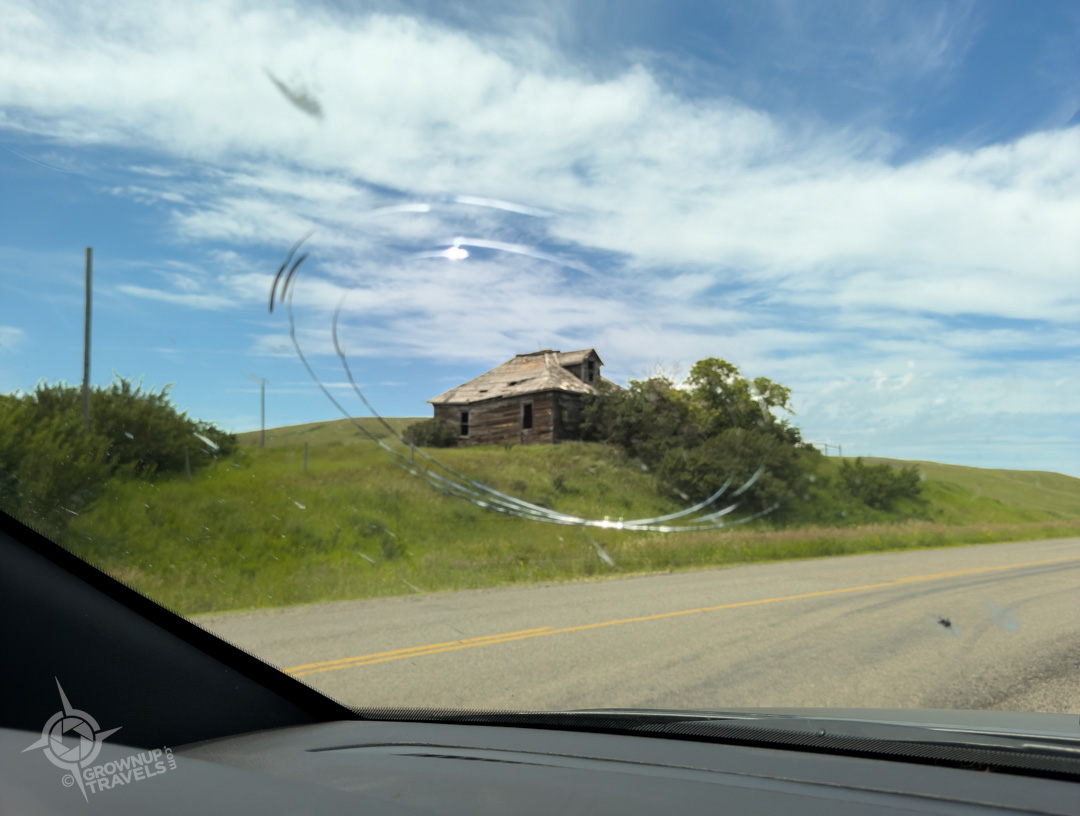
Hail damage like this one on Craig’s vehicle is an occupational hazard for storm chasers
To avoid these risks, you need a road system that provides plenty of options, and Saskatchewan has the largest road system in the country – 250,000 km of them. Southern Saskatchewan is particularly good, thanks to its grid-like network of roads running between huge tracts of farmland, making it the ideal terrain for both chasing storms and staying safe. Because with both east-west and north-south roads criss-crossing regularly here, there are always options available should you need to run from a rogue storm.
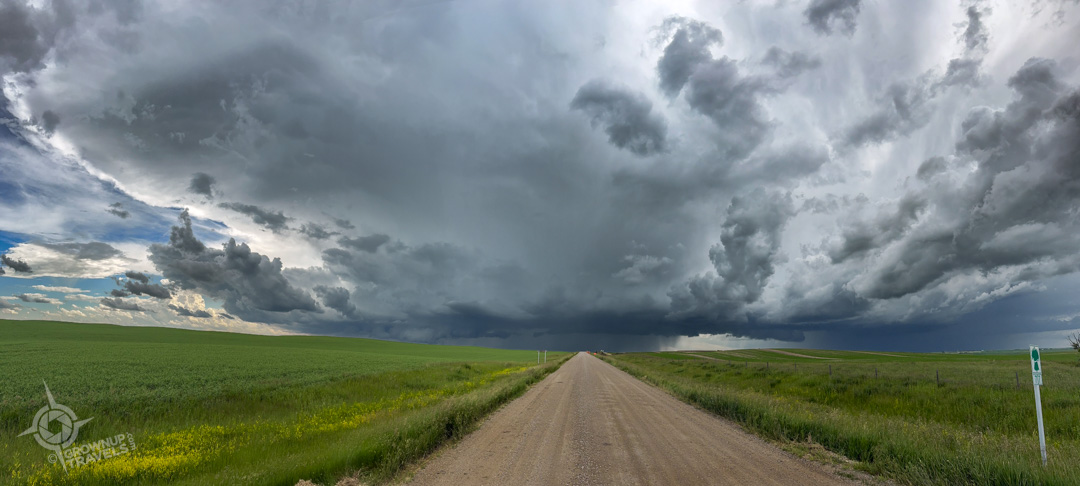
The road network in southern Saskatchewan is idea for chasing and avoiding storms
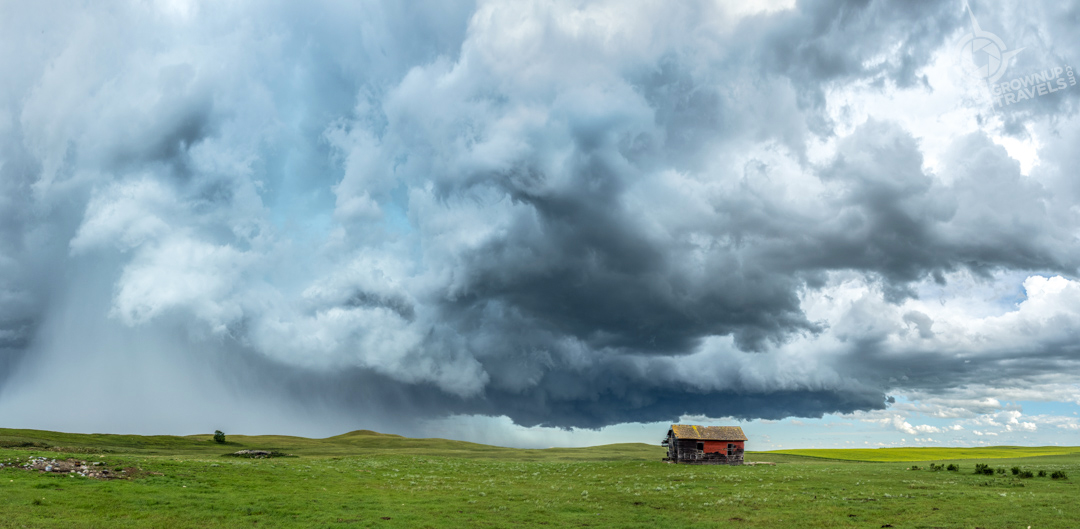
The turquoise colour high in the clouds is the hail core with light shining blue through the ice crystals
A Storm Chaser’s Day-in-the-Life
Every storm chaser will tell you the same thing: a typical day involves what can be a lot of driving, a lot of waiting and then a frantic burst of manic activity. On our first day, the tire blow-out day, we had already driven for several hours before eventually catching a system that produced a lot of rain and a pretty dramatic-looking ‘shelf’, (a rolling cloud wall extending for miles across the leading edge of a storm).
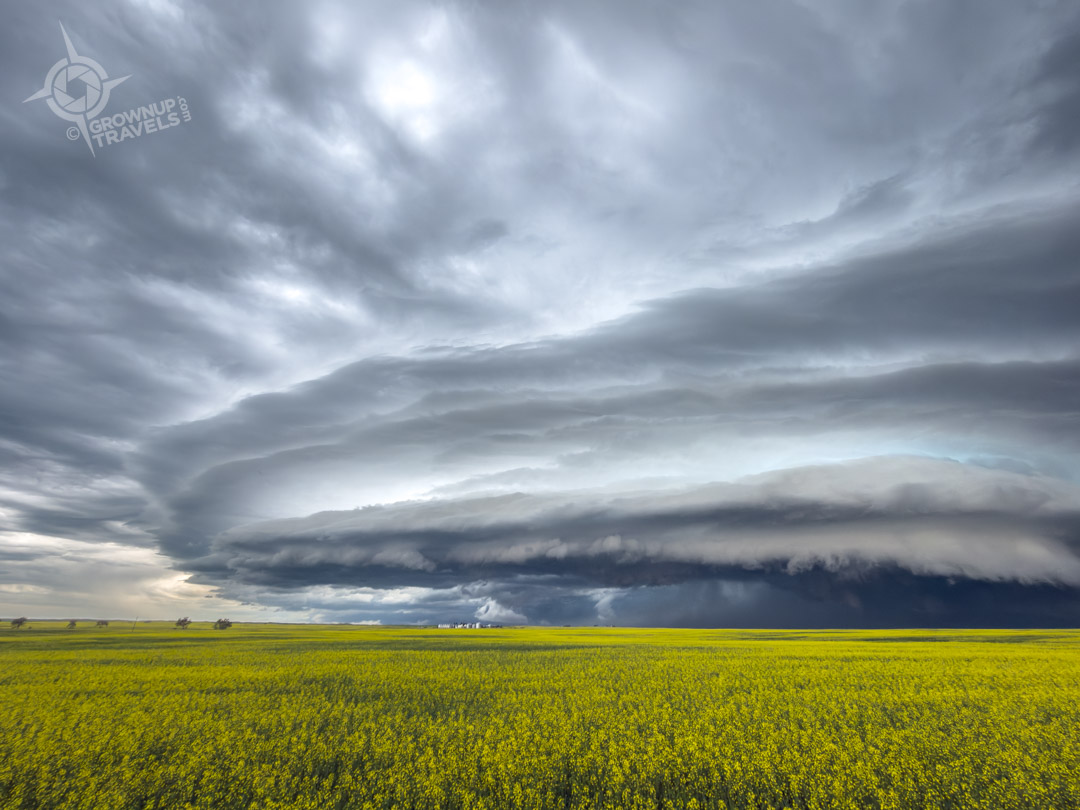
But as photo-worthy as this was, it lacked the towering supercell structure that experienced storm chasers are always hoping to see.
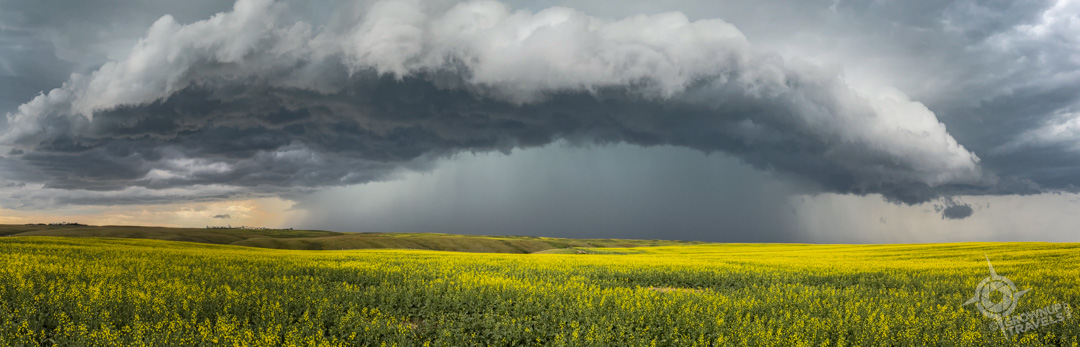
This ominous-looking system loomed over the landscape for kilometers dropping rain and hail
Another day we spent almost 16 hours in a car, chasing an elusive system in the northwest of the province that never lived up into its potential. We did, however, stop to capture a lightning show on our return that was impressive enough to make the drive almost worth it (at least for us rookies).
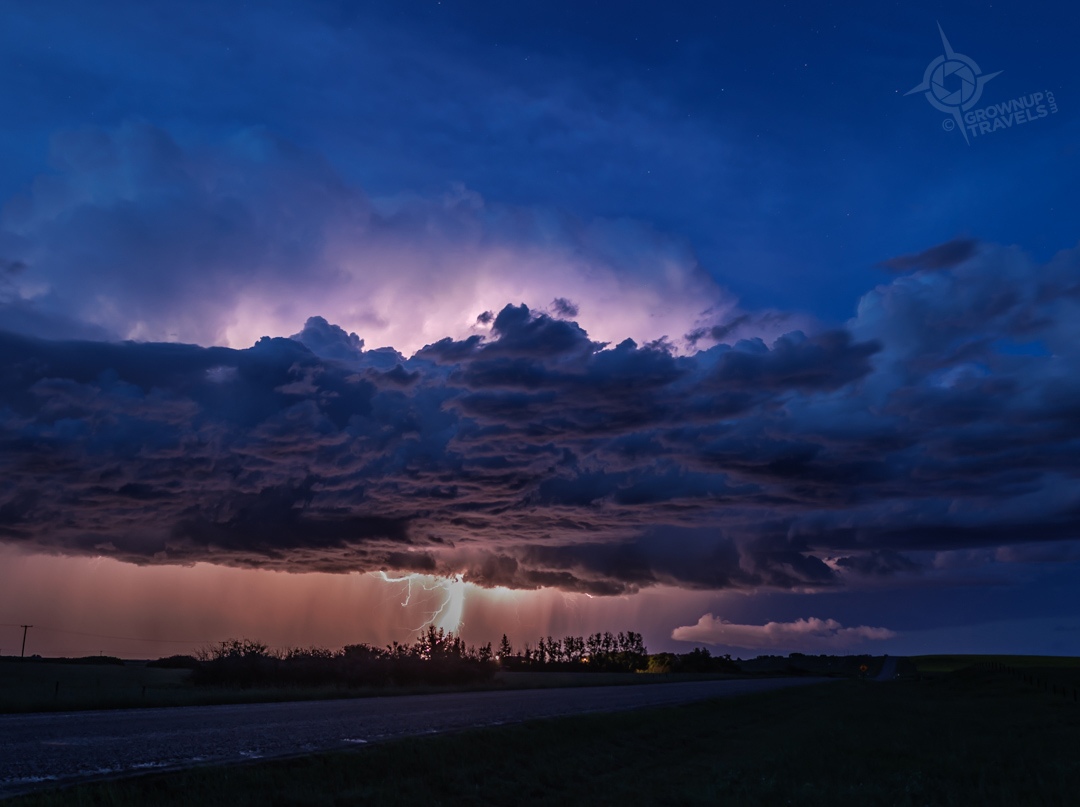
Supercell or not, this storm delivered a great evening show
Yet another afternoon saw us parked for hours by a canola field waiting for a storm to develop, passing the time photographing baby ground squirrels playing in the grasses beside a farm field.
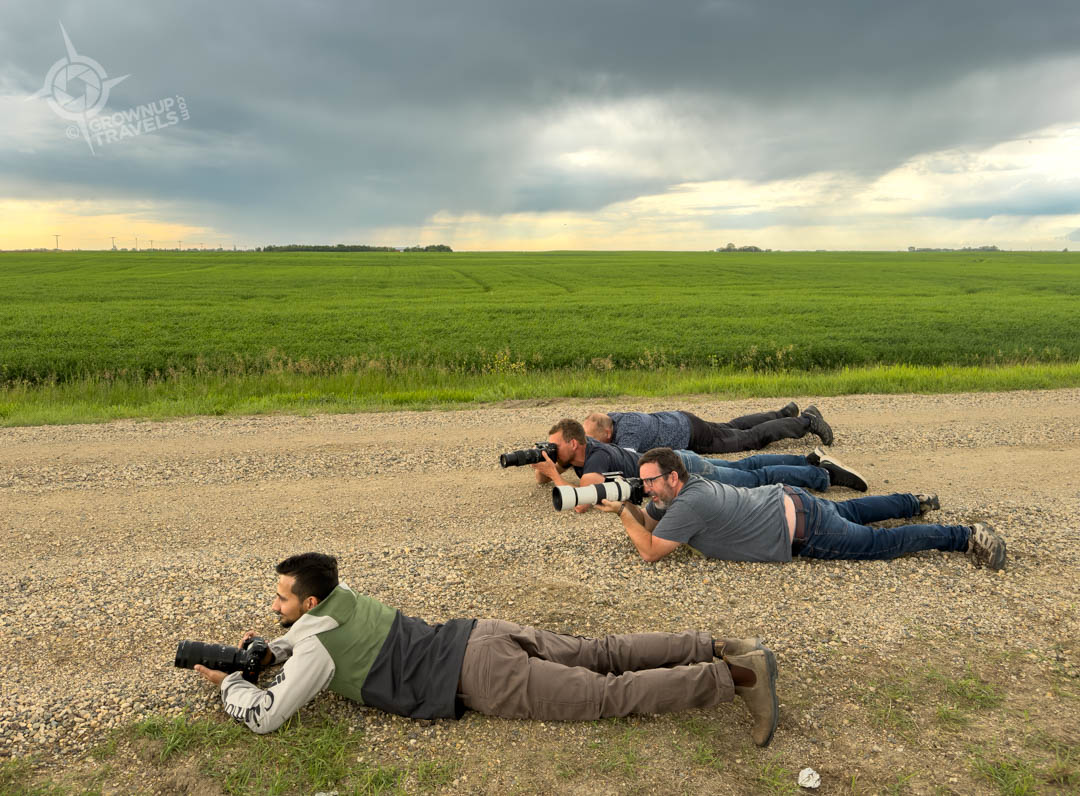
‘Shooting squirrels’ while waiting for the storms to develop
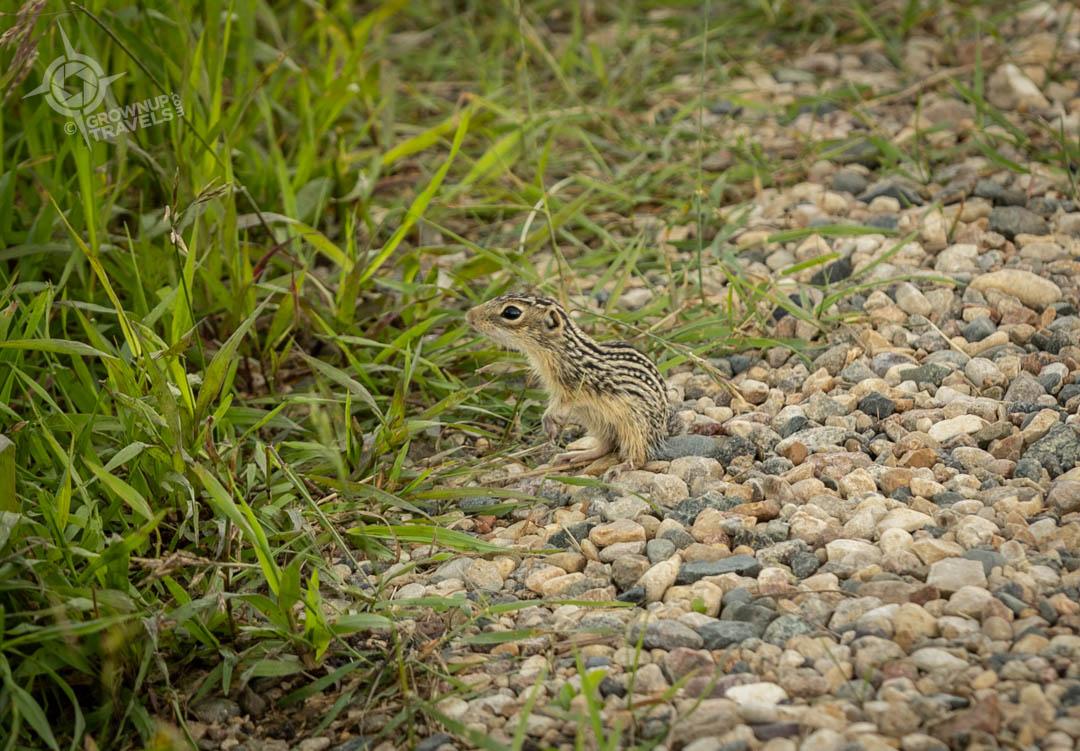
A family of baby ground squirrels kept us entertained while waiting for the storms to intensify
This of course, is the beauty of a Saskatchewan photography tour (pun intended): there is always something to shoot here, regardless of whether there is a storm on the horizon or not. A decrepit grain elevator or homestead makes for a wonderful subject, the landscapes of Grasslands National Park are as varied and colourful as a box of crayons, and there is always the chance to see wildlife, whether it’s an elusive pronghorn or a curious prairie dog.
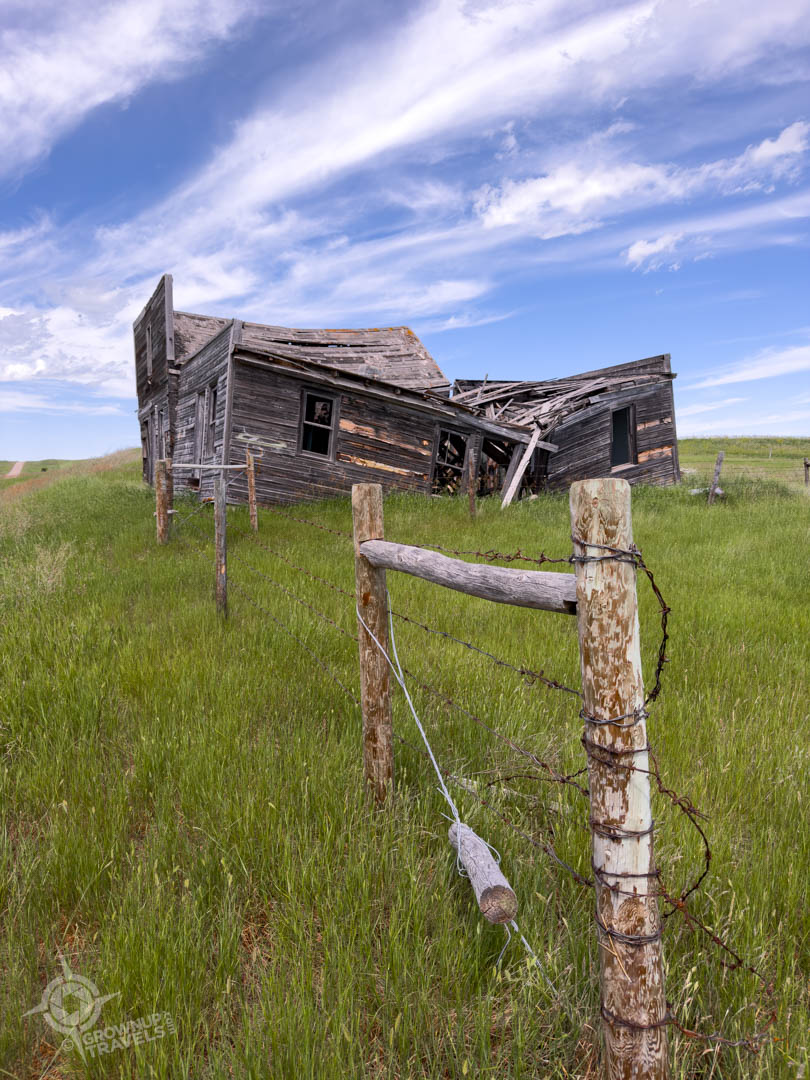
Photo ops are everywhere in Saskatchewan
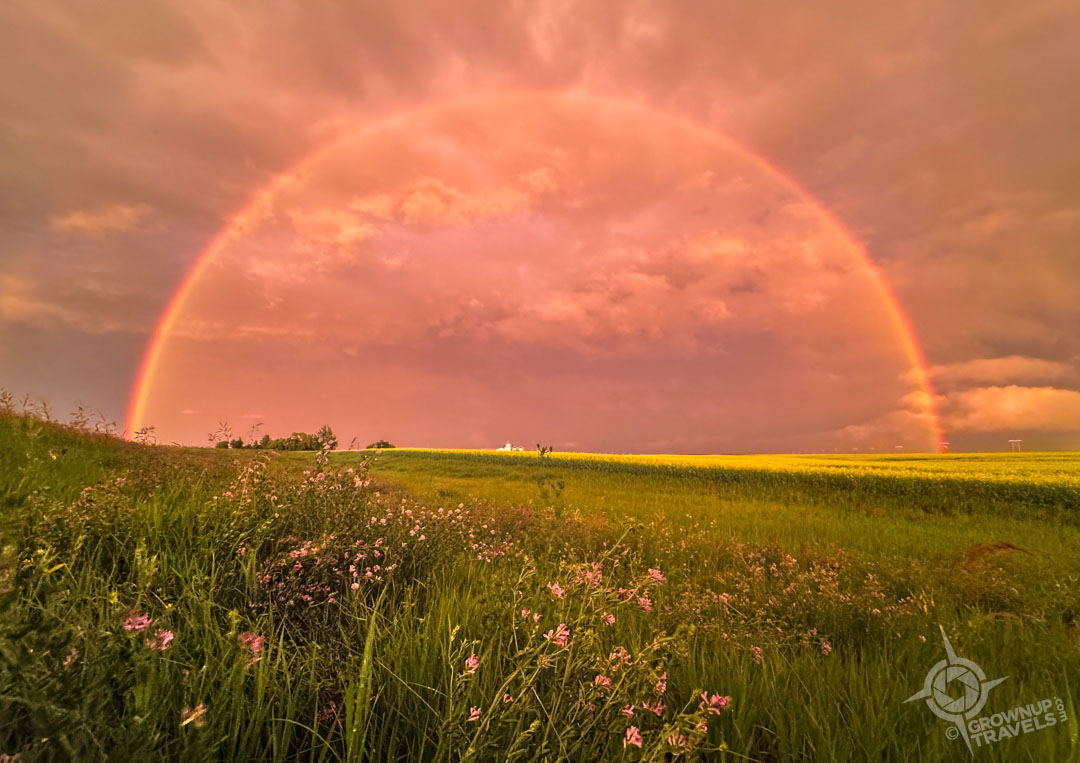
A double rainbow with pink skies near Weyburn, Saskatchewan. The perfect end to a day of storm chasing.
The goal for avid storm chasers however, is that truly special ‘Moby Dick’ of weather systems: a spectacular supercell. And we got lucky.
Our ‘White Whale’
The day started with several hours of driving under sunny skies towards the southeast of the province where some fluffy cumulus clouds were starting to bubble up in the sky. Craig was driving while simultaneously keeping an eye on radar and weather data models, trying to decide which of two potential storms to chase, hoping one might reward us with a beautiful storm structure. There were a couple of promising candidates that made the decision difficult. Like putting money on a horse race, he was gambling whether to bet on the longshot and score big at the finish line or follow the favourite and just get another ‘shelf’ instead. Ultimately, it came down to Craig’s gut instinct and experience, as he moved us into position for the lesser of the two storms.
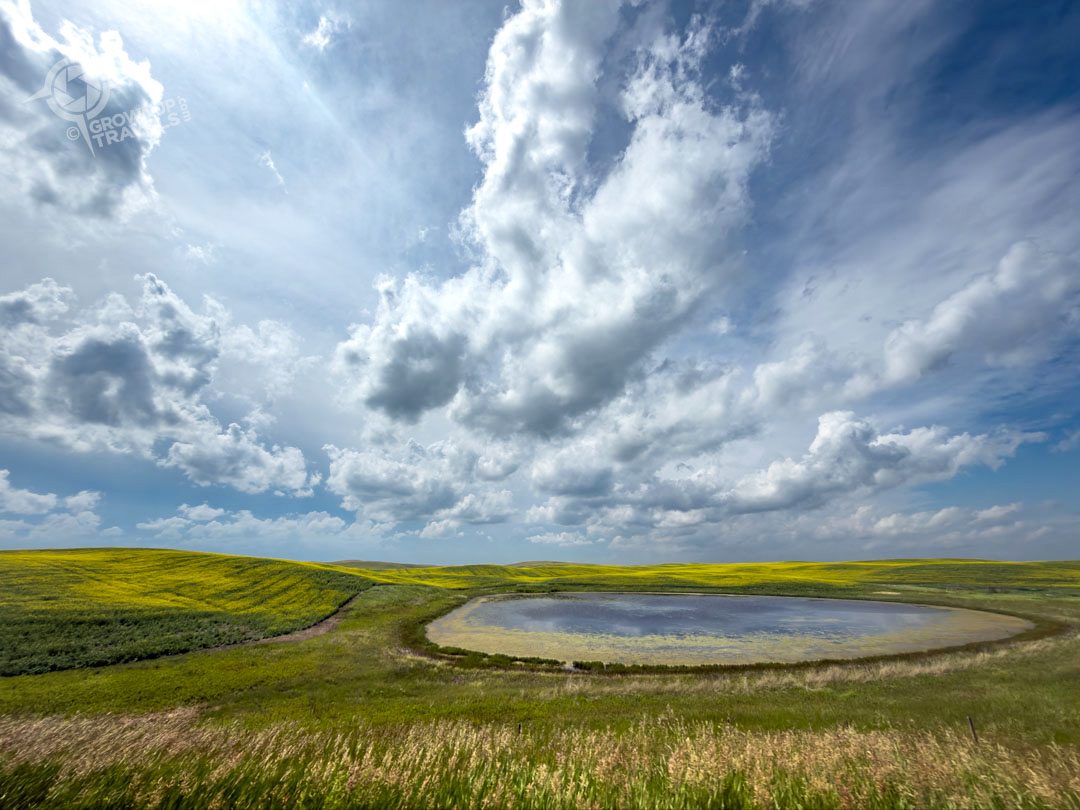
The day can start with sunny skies, and end with something very different.
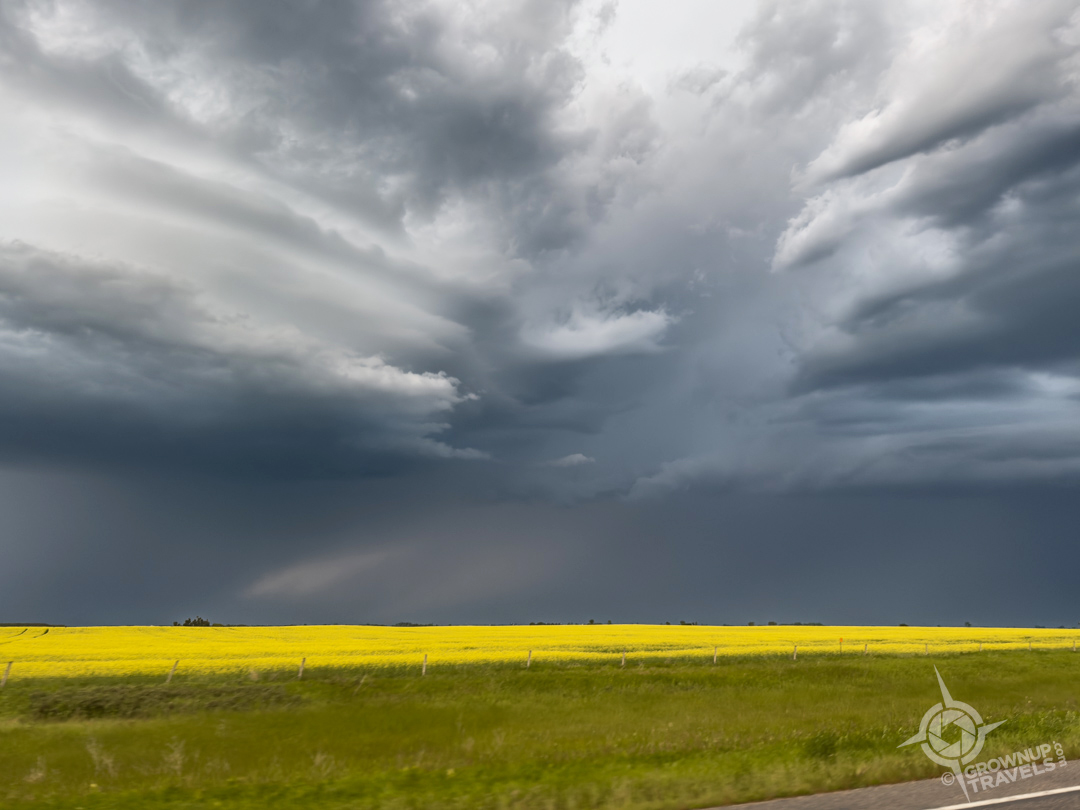
Dark blue-grey storm clouds stand out dramatically against the neon yellow of canola fields in full bloom.
Instinct paid off. A beauty of a storm began forming, slowly establishing a base of clouds that had circular rotation and a tower rising high up in the atmosphere. ‘Pancake’ layers of cloud began to stack above that base, and we stopped to grab a few photos.
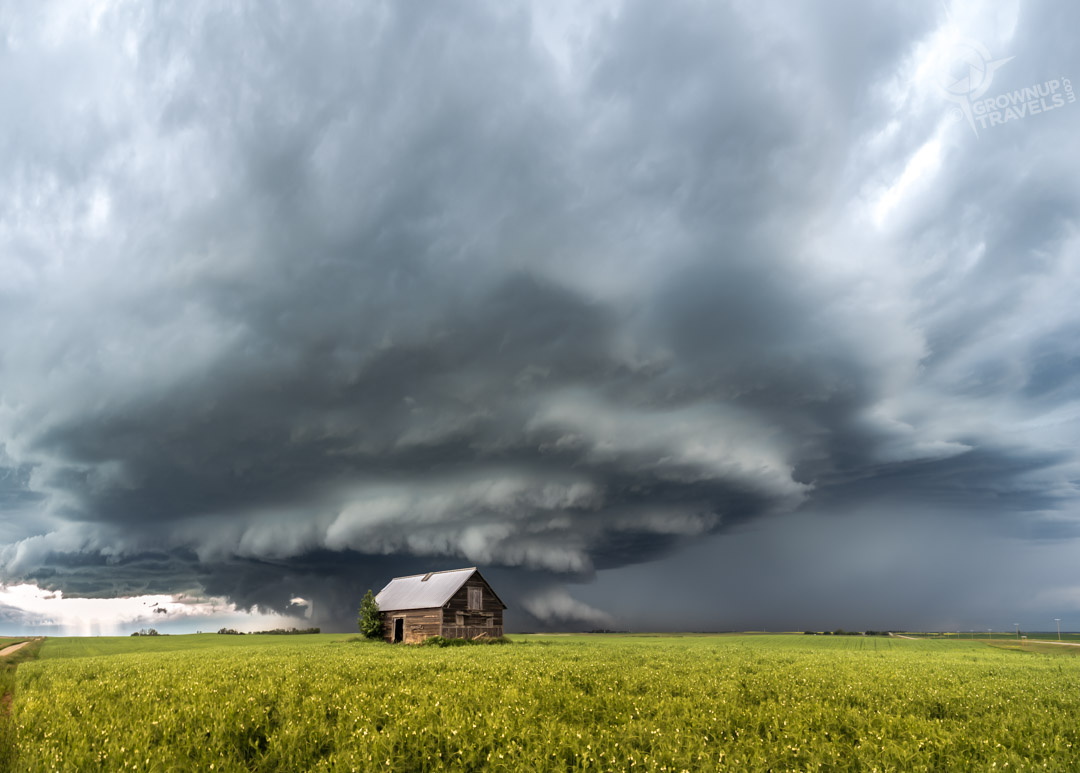
A super cell began forming over this field
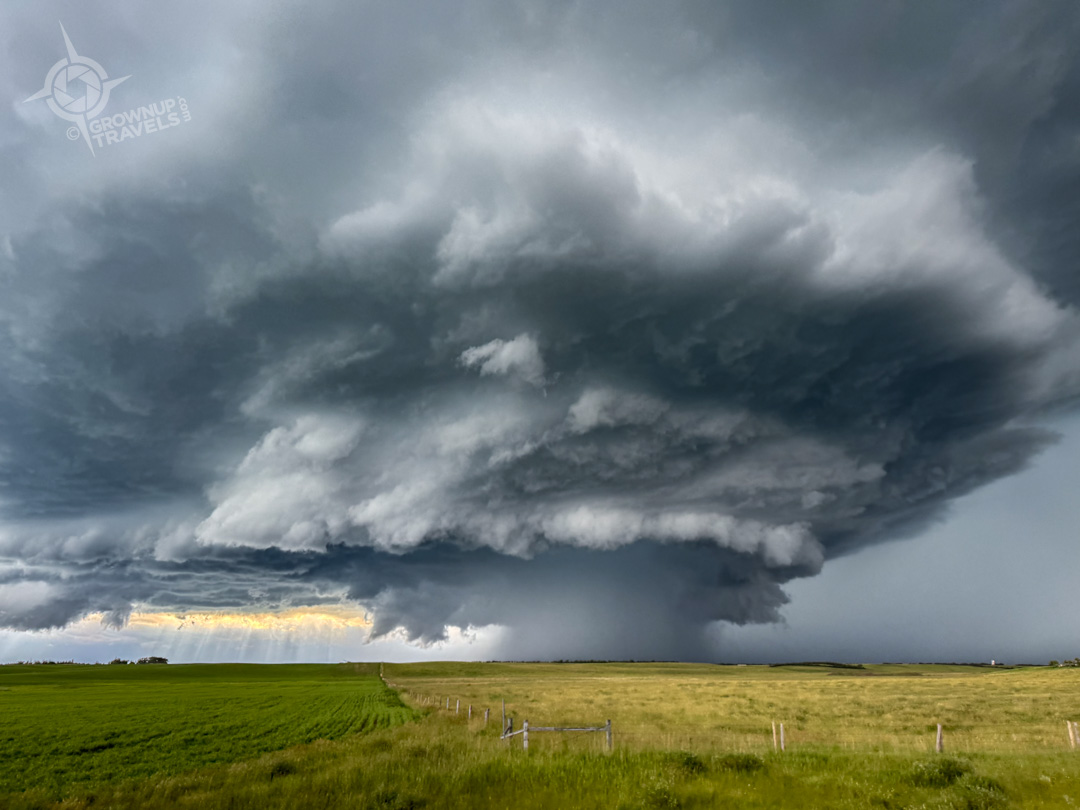
This storm just kept getting more impressive as we were driving alongside it
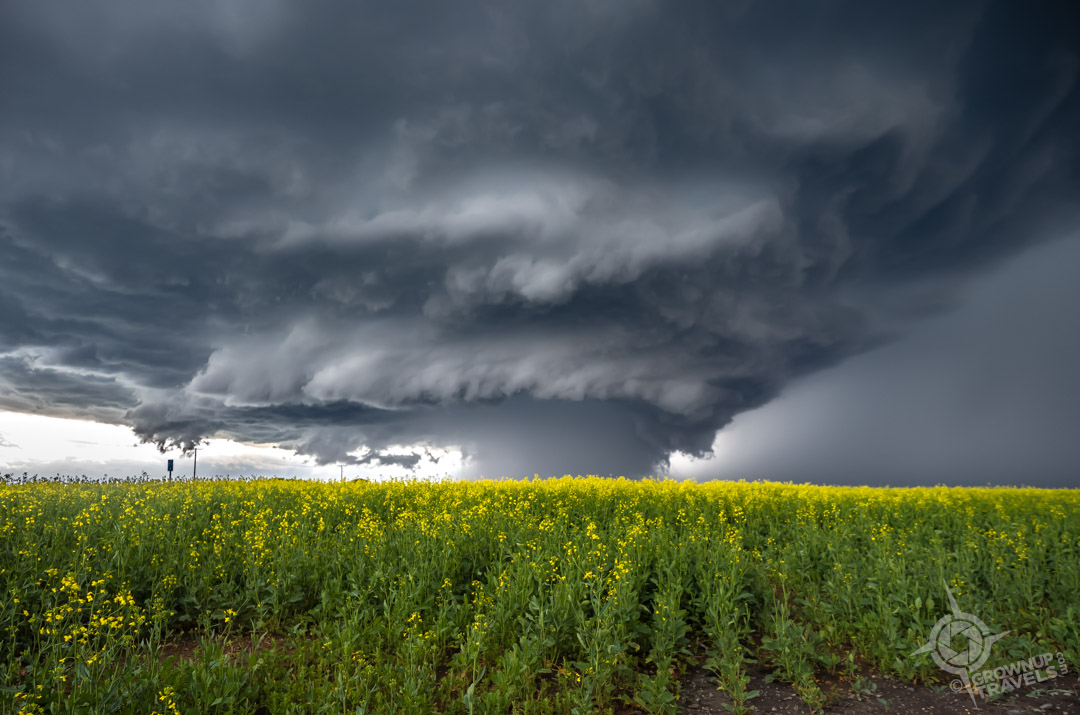
We stopped to take photos of the super cell over a canola field
This was just a teaser location, though, before continuing on our way to an even better position to view the storm. We pulled off the road again, this time with the front of the storm moving to the side of us, hurriedly grabbed the cameras and tripods, and set up to capture the storm. Before we knew it, the rotation in the lower cloud base started to consolidate into a shape. The shape of a funnel!
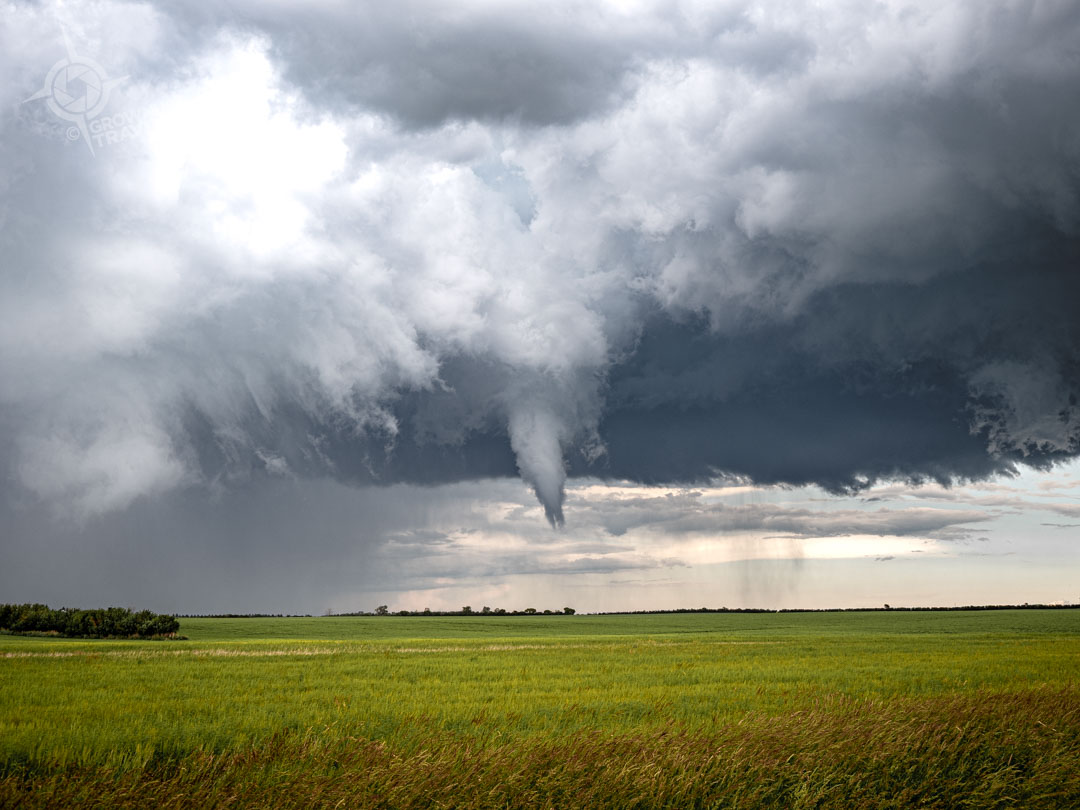
Witnessing what we thought would be a ‘tornadogenesis’ at the base of the super cell was an adrenaline rush!
Steak Tonight!
There’s a superstition amongst storm chasers that you never eat a steak dinner during a chase tour unless you actually see a tornado. Watching this incredible cloud sending down a spiraling cone, we all thought tonight might be a ribeye kind of night. My excitement was off the charts: alternating between the instinctive flight response of wanting to get in the car and run, and the equally powerful freeze response, rooting me to the spot as I watched the amazing spectacle of a tornado forming in front of my eyes. All accompanied by the soundtrack of a ‘hail roar’ from the outpouring of icy pellets hitting the ground in the distance.
As we watched our wannabe tornado stretching towards the ground, we soon realized that it didn’t have the energy to sustain itself. It became more disorganized, and before long it appeared no more menacing than a Dairy Queen swirl, eventually getting swallowed back up into the storm’s base. As my heart rate returned to normal, I began to understand the fascination that comes with storm chasing. Official tornado or not, it was more than enough for me just to have witnessed a ‘tornadogenesis’. I was hooked.
Same Storm, So Many Different Photos
We followed our longshot of a storm for the rest of the afternoon, and it never stopped giving. Increasing wind shear at altitude began pushing the higher clouds into an extended shape known as the ‘anvil’, creating an entirely different look to the storm. Tendrils extended from the front of the anvil in ragged shapes that looked like teeth. Time lapses showed the progress of the storm as it evolved and morphed into a different beast.
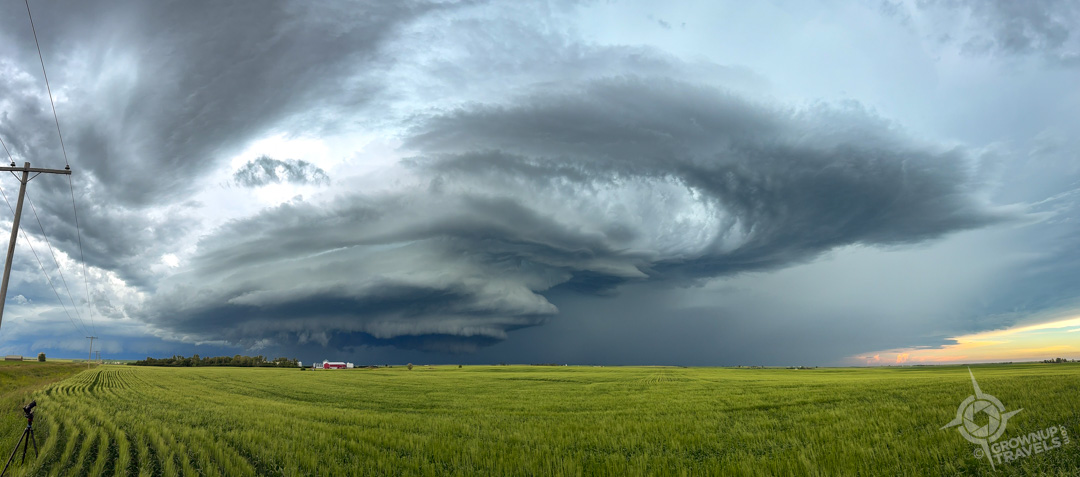
The anvil shape to the right, formed by wind shear pushing the upper layers of the cell
We pulled off the road multiple times, grabbing cameras still mounted on tripods and ready to go in an instant for that ‘hurry up’ moment. We composed shots beside a canola field in full bloom, its bright neon yellow colour providing a contrasting foreground for the deep blue clouds. Another photo included a farm which helped contextualize the size of the supercell. I half expected an alien mother ship to emerge from the roiling clouds hovering above it.
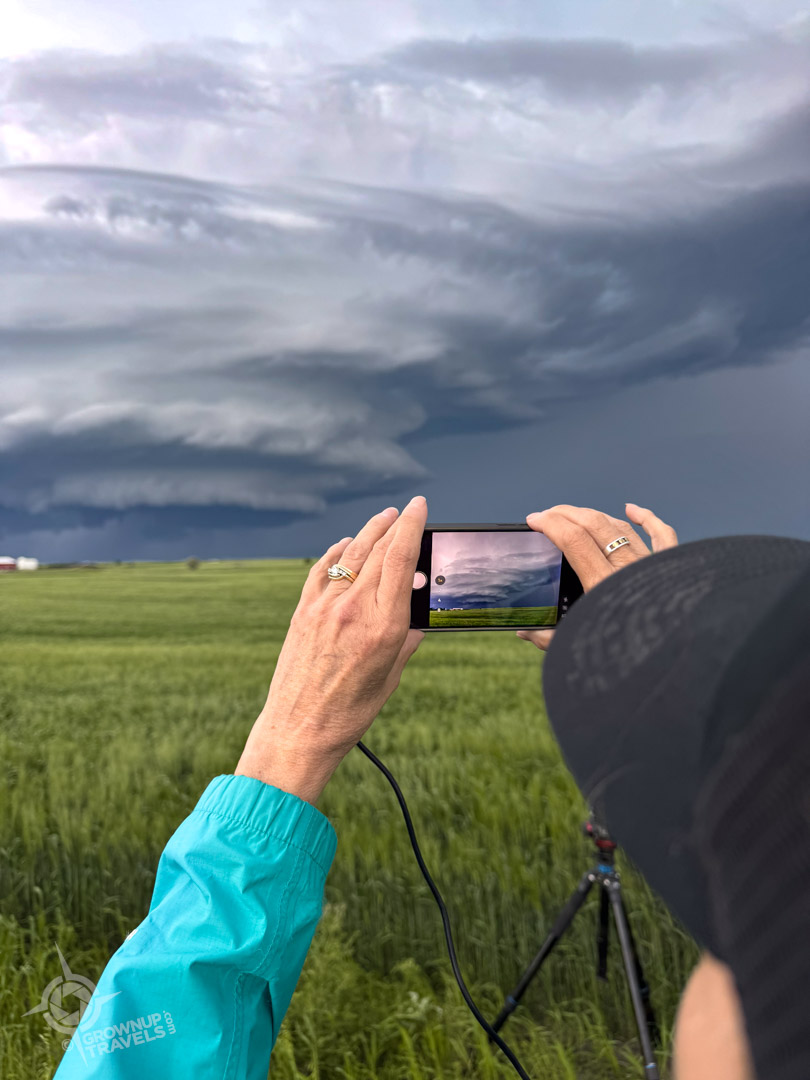
One storm-chasing trip and I was hooked!
This too is what makes storm chasing so addictive: every storm is different, and even the same storm can appear radically changed throughout its life cycle. Capturing it in photos is never the same twice, and every experience with every storm is unique.
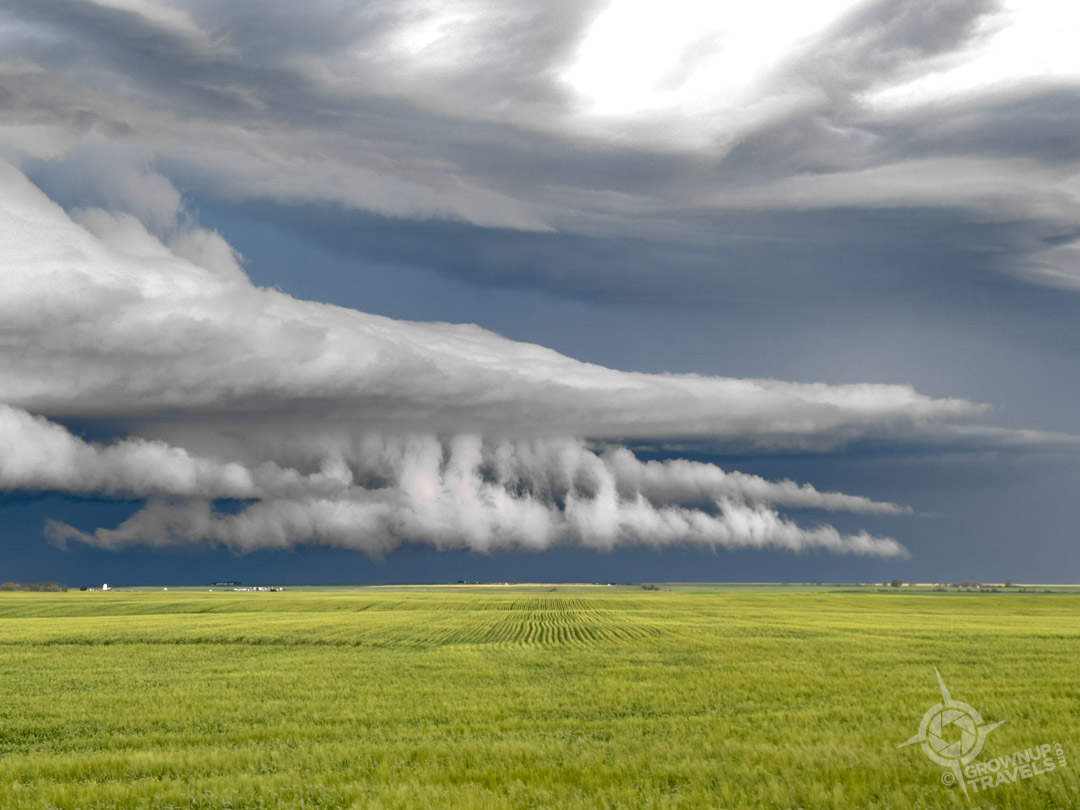
Clouds that looked like teeth formed at the front of the storm
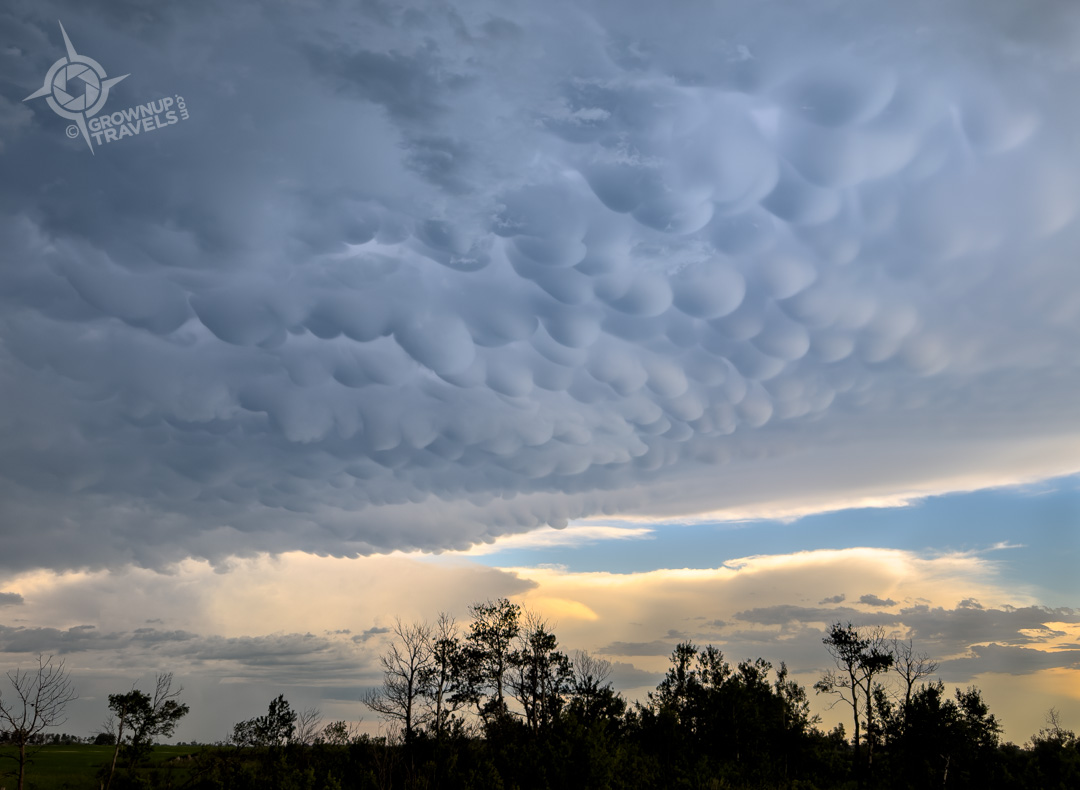
These mammatus clouds (nicknamed ‘boobie clouds’ for obvious reasons!) often form near a super cell
A Bucket List Item That Wasn’t Even on the List
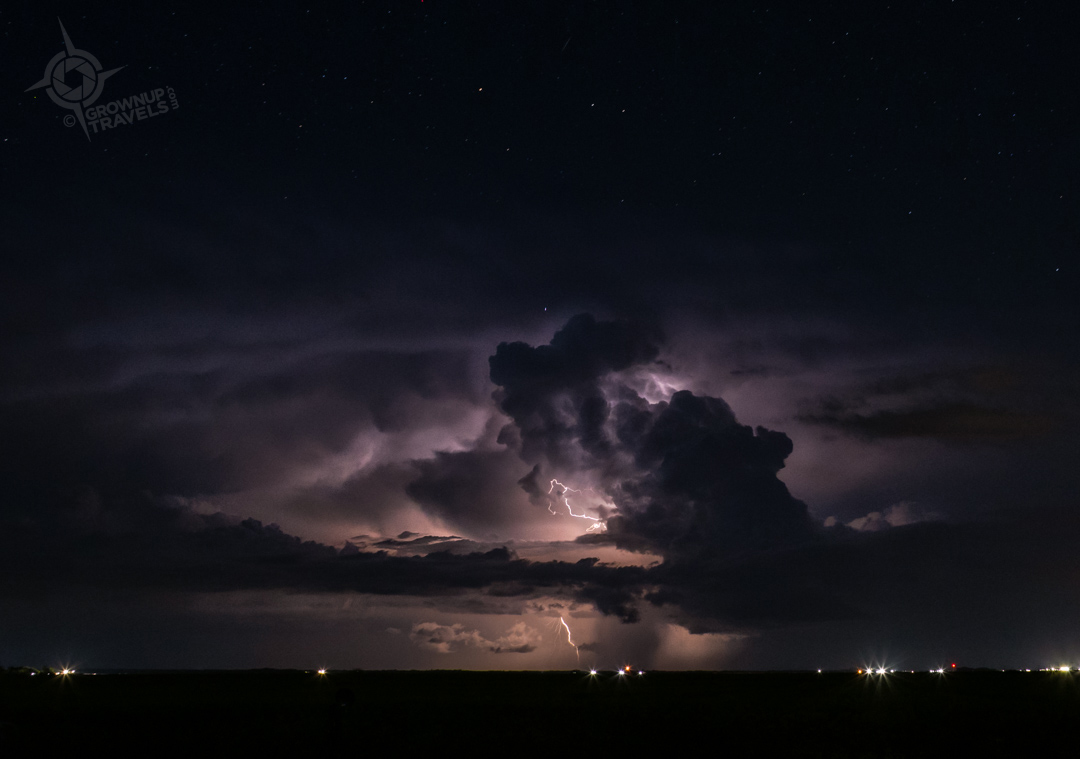
Lightning and stars to end another exciting day of storm chasing in Saskatchewan
I may have watched a couple of tornado-themed disaster movies back in the day, but I would never have imagined that a storm chasing tour in Saskatchewan was a thing. At least not a thing for sane, reasonable humans to attempt. And let’s be clear: this is very much a kids-don’t-try-this-at-home adventure. The danger is very real, and the damage that these storms do can be devastating for both people and property. But with the experience and knowledge of expert guides and a safety plan always top of mind and in place, this unusual tour was a once-in-a-lifetime opportunity to capture images of Mother Nature in all of her magnificent power and fury.
And that is one experience I will never forget.
Get a Taste of Storm Chasing: Watch This Video From our Tour!
PRACTICAL TIPS & INFORMATION FOR STORM-CHASING IN SASKATCHEWAN
#1 TIP: Leave this to the professionals. Scott and Craig of Living Sky Tours have years of experience doing this, and know how to chase storms while keeping the safety of their guests a priority. Their website provides comprehensive information about their tours and what you can expect.
TIMING: Late June to mid-July is ideal for chasing storms in Saskatchewan, mostly because of weather conditions. (Even the canola fields in full bloom contribute to the moisture content required for ideal for super cell development.) This timing is not set in stone, of course, but if you are trying to time your visit for the best potential storm season, early summer is best.
BE PREPARED: Storm-chasing is not for the faint of heart – nor of bladder! There are no restrooms on country roads, and days can be long with little or no stops at places with proper bathrooms. Be prepared to ‘water the wheels’ discreetly if Mother Nature calls, and maybe forgo that extra cup of coffee in the morning. Similarly, your ‘dinner’ may consist of a sandwich that you picked up in the morning and some road snacks that you bring along with you.
CLOTHING: Storms tend to change the air temperature pretty dramatically in some cases: one minute it is a warm sunny day, then the clouds slide over, the temperature drops significantly, and the rain starts. Dress in layers, and have a rain jacket with you. And since you will be on gravel roads and/or the edges of fields, proper closed shoes (runners or hikers) are the best choice, preferably waterproof, since some roads can become muddy.
PHOTOGRAPHY: Scott and Craig are there to help you capture the best images possible, since this is a photography tour first and foremost. Whether it is with your cell phone, or a sophisticated digital camera, they will offer advice and tips, and will cater to the knowledge and expertise of their clients.
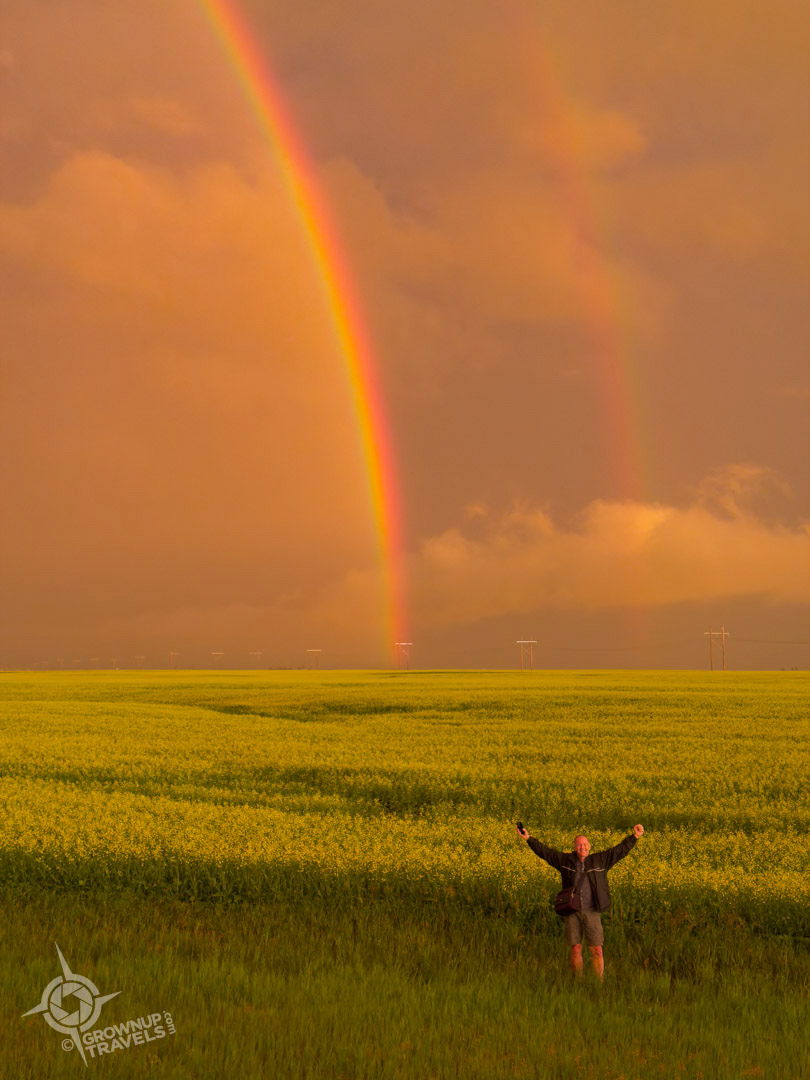
Special thanks to Tourism Saskatchewan who hosted Henk and I on our storm-chasing tour.

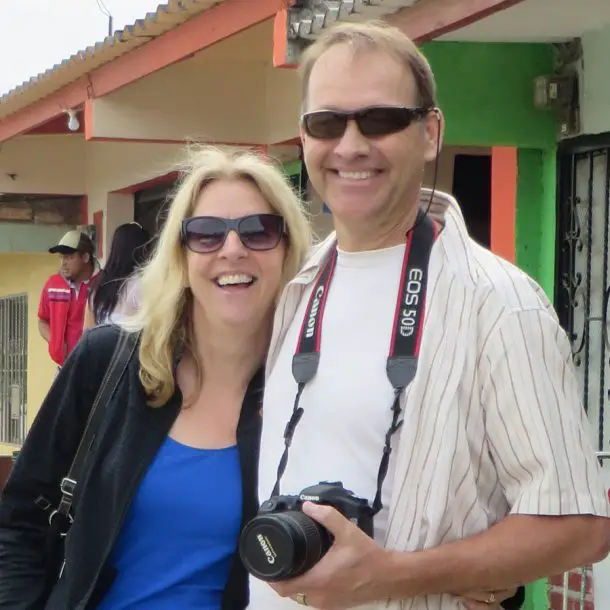
Jane is an award-winning travel writer and photographer and an accredited member of the Travel Media Association of Canada (TMAC). In their annual awards competition, TMAC named GrownupTravels.com as the Best Self-Published Travel Blog in 2025 .
She is also a member of the North American Travel Journalists Association, and a freelance travel writer contributing to both print and online publications.




Subscribe and you'll never miss an update!
Join our mailing list to receive the latest news and updates from Grownup Travels. (We keep your email STRICTLY private)
Thank you for subscribing to Grownup Travels!