
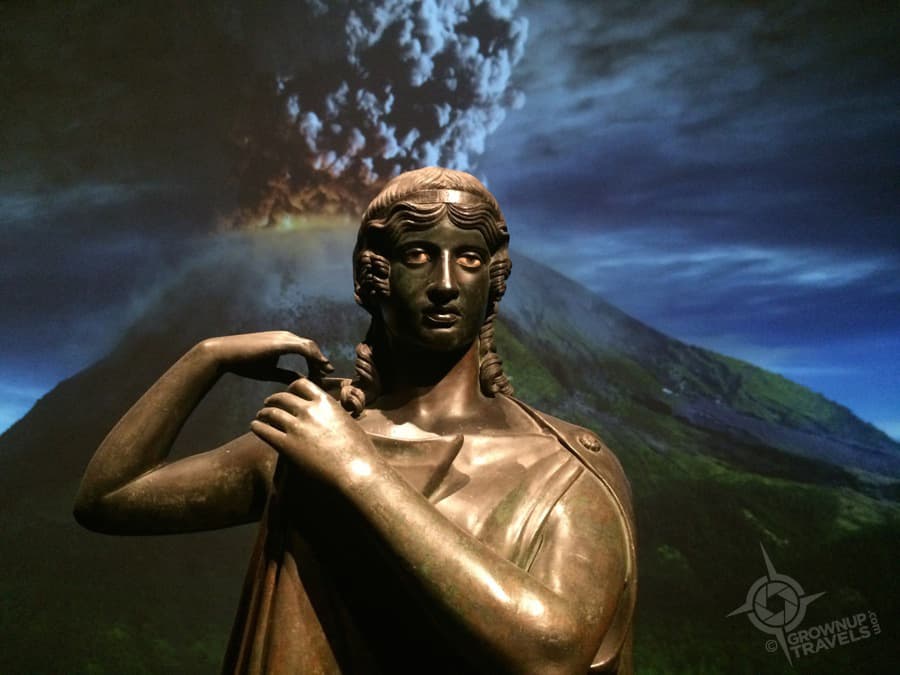
Some very clever advertising folks have christened the current exhibit at Toronto’s Royal Ontario Museum #ROMpeii, which is more than just a great social media handle: it actually reflects the partnership between Canada and Italy, whereby the ROM has been able to bring over some of the best artefacts of Pompeii to Toronto. Henk and I checked out this exhibit recently and agree that it is well worth a visit. Here’s why.
For anyone who has been to the actual site of Pompeii, you know that the grounds are huge, and it’s almost impossible to see all of the site in one visit. And as impressive as it is to see the excavated houses with their mural-covered walls and gracious atriums, many of the more fragile and delicate items discovered in these homes are not on display at the site itself. Which is what makes the exhibit at the ROM so interesting: seeing some of the everyday items used by Pompeii’s residents brings the ancient city and its people back to life.
Dine Like the Mediterraneans

Carbonized bread from a commercial bakery in Pompeii
Wealthy Pompeians loved to eat good food, and the evening meal was the big food event of the day, with only light snacks eaten at breakfast and mid-day. Bread was a staple and was eaten with honey or dates in the morning, and with cold meats and vegetables at lunch. One of these loaves of bread from a commercial bakery is on display, ‘surviving’ because it was carbonized instantly ? essentially cooked in seconds by the super-hot gases that engulfed the city.
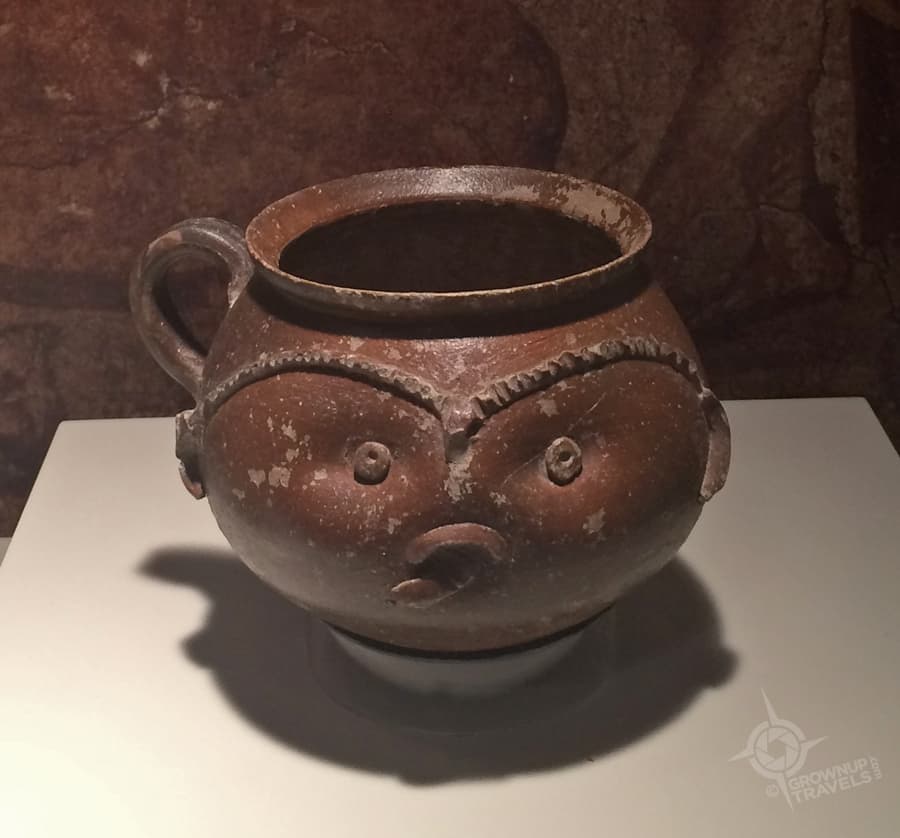
But when I saw this whimsical cup, I couldn’t help thinking that it belonged to someone who probably liked to start his day off with his ‘favourite mug’, (even if coffee-drinking in Italy didn’t start until centuries later.)
Dine in, not out.
In ancient times, unlike today, restaurants catered to the lower classes, so any “fine dining” in Pompeii happened at home with the help of skilled slaves and kitchen staff. Multi-course dinners took a lot of effort and required a fully-outfitted kitchen, and some of the many objects used for preparing and serving meals are on display in the museum, and are surprisingly well-preserved (even delicate glass platters that have survived intact!) Surprising, too is that some of the kitchenware is very modern-looking like this frying pan whose design hasn’t changed much in 2,000 years (note the pouring spout that we all recognize from cast-iron frypans of today).

Good design doesn’t change in 2,000 years.
With Pompeii being so close to the sea, fish was one of the favourite foods fried up in that pan, but fish motifs also figured prominently in home decor, mosaics and painted frescos.
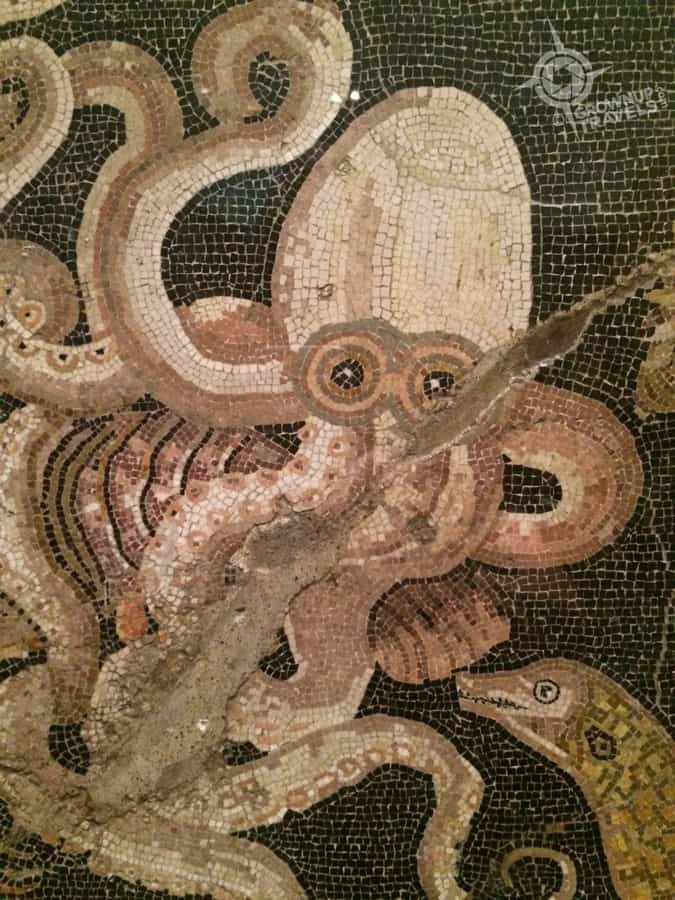
Detail of octopus from a mosaic featuring all kinds of ocean creatures

Fish detail from mosaic
House Proud in Pompeii
Homeowners 2,000 years ago took as much pride in their house design and decor as we do today, and every well-to-do house in Pompeii included an atrium and gardens where marble statuary was used to beautify the home both inside and out. Favourite subjects were mythological gods and goddesses, as well as decorative urns, pillars and fountains.
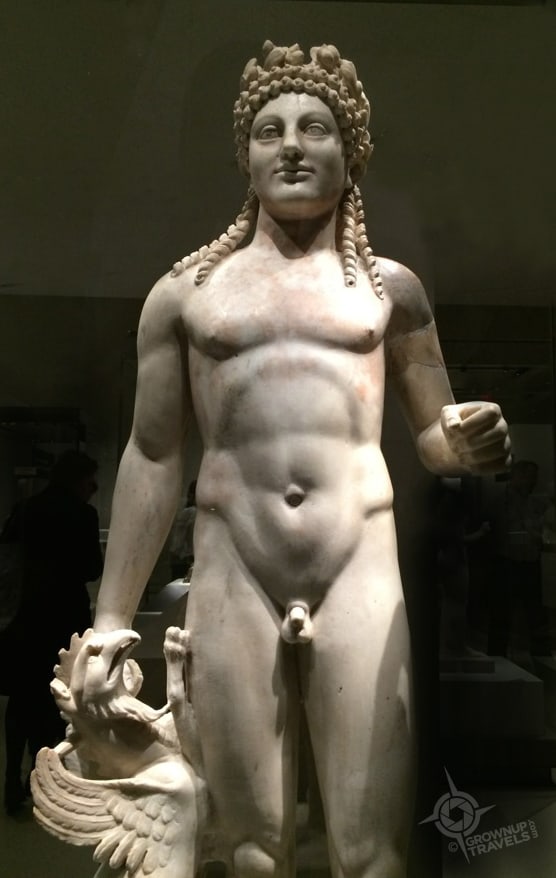
Marble Apollo
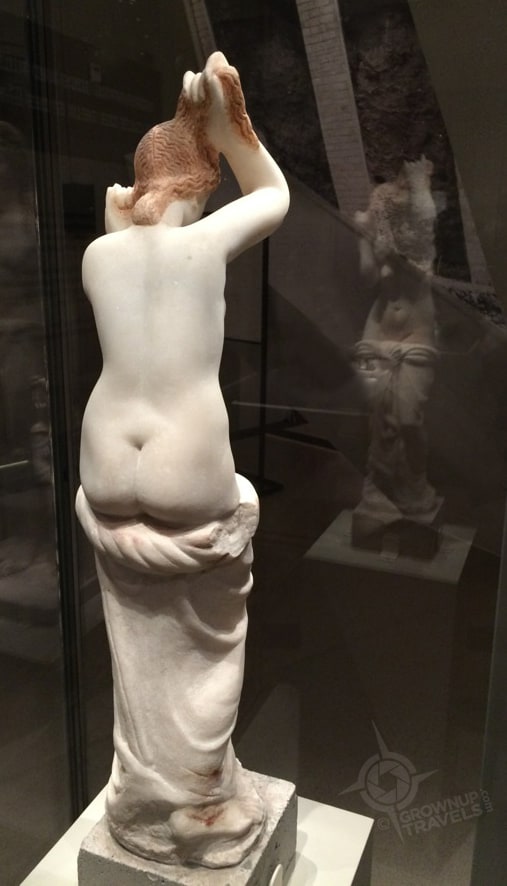
It’s almost like she’s looking at her reflection
Inside, nature and mythology were also the subject of paintings and murals that covered the walls of both public and private spaces.
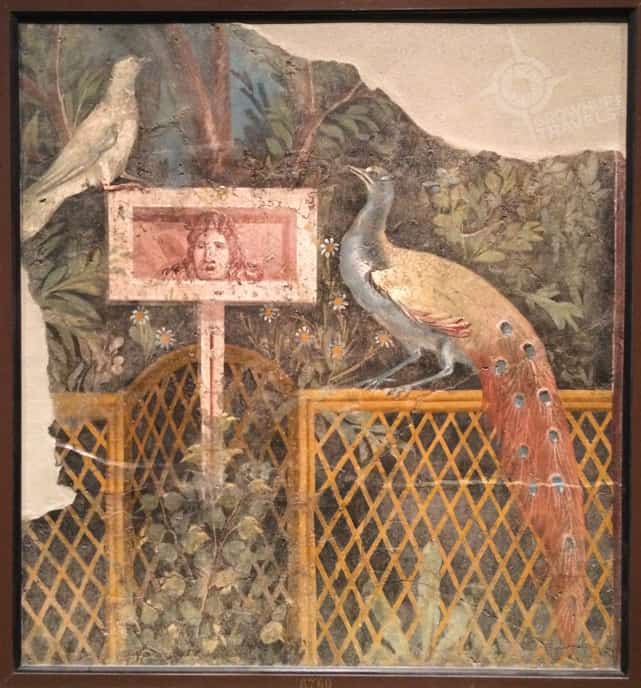
Fresco fragment that “brings the outdoors in” with images of gardens and birds.
There were also portraits of many prominent Pompeian family members found in these homes, some painted, some done in mosaic, some sculpted in marble. Many of these representations idealized the features of the individual, or mimicked hairstyles of the ruling Romans of the day, as a way to elevate the image of the person. Others were more realistic portraits, accurately portraying their age and features, like this gentleman’s very prominent “Roman nose”.

Is it just me or does he look like Jean-Luc Picard (Star Trek TNG)?
Pompeii’s Taste for the Arts
What did these ancient people do for fun? Pompeians loved theatre, so much so that there were 2 theatres for this city of 12,000 residents, one open-air amphitheatre that held over 6,000 people and another covered stage were 2,000 attendees could enjoy the popular comedies and dramas of the day.
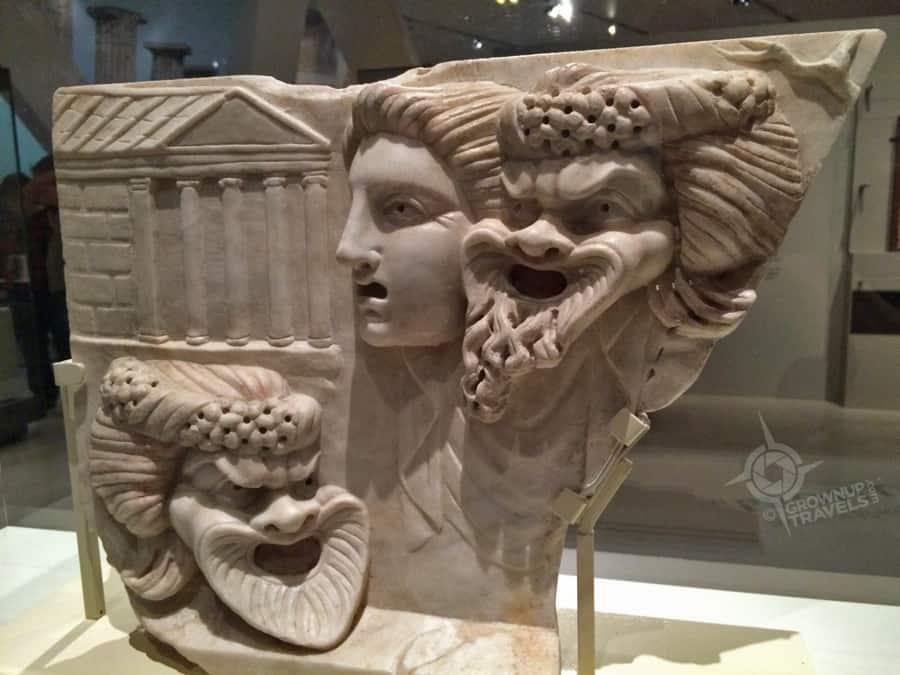
Theatre masks and theatre architecture displayed on this marble relief
Sex and the City
And speaking of fun, sex was just another part of everyday life in Pompeii, and was represented everywhere in graffiti, wall paintings, home decor and erotic sculptures. Sex wasn’t a taboo subject and these sometimes explicit items held pride of place in gardens, bedrooms, dining rooms, and brothels, symbolizing everything from good luck to fertility to mythology. But when they were first discovered in the 18th century, and even until the mid 20th century, these erotic items were kept hidden from the public in sealed collections that you needed special permission to view. Even in the mid-’80s when I visited Herculaneum (another ancient city destroyed in the eruption), our guide ‘warned’ me before we entered one house where there was a particularly well-endowed statue on display in one of the rooms.
Times have changed, and some of these objects are included in the ROM exhibit, but as this is a family-friendly exhibit, this area is sectioned off with a ‘for grownup eyes only’ advisory that it may not be appropriate for everyone. Here’s one of the more “interpretive” anatomical examples.

A wind chime ‘for grownups only’.
Tragedy in the Everyday
There is great poignancy in some of these everyday items, reminding us that Pompeii was not just the site of a natural disaster, but of a horrific human tragedy as well. An entire city of 12,000 men, women and children was wiped out within hours, and even inanimate objects help to tell part of this story like these glass vessels that probably melted in the cupboards where they were stored from the heat of fires caused by the descending ash and super-heated gases.
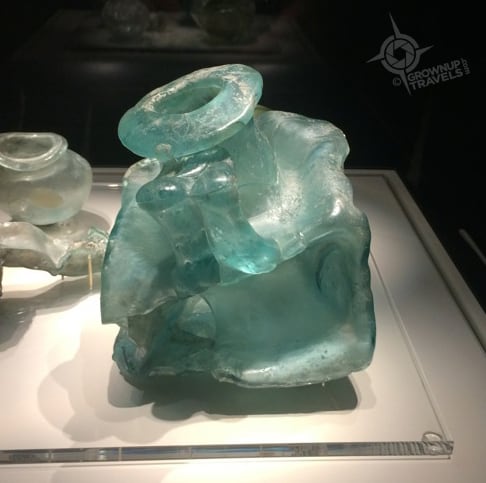
Melted glass vessel from Pompeii
But there’s no more powerful testament to this tragedy than the plaster casts of the victims themselves. The casts were made by pouring plaster into the cavities left in the hardened ash after the organic material of the bodies decomposed, creating a 3-dimensional portrait of each person at the time of his or her death. Any parts of the skeletons that remained also became incorporated into these plaster figures, and for this reason, the original casts are not taken out of Italy, since they contain human remains. But even though the casts on display at the ROM are reproductions, they are no less powerful.
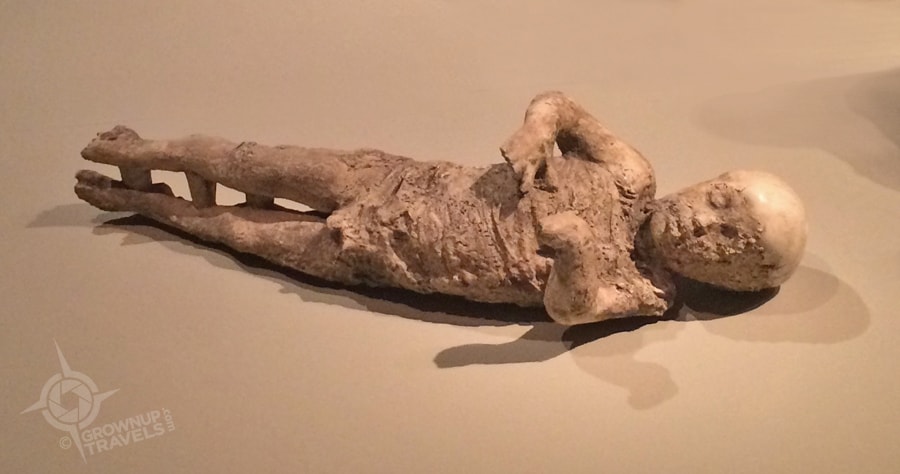
Young and old fell victim to toxic ash and fumes, dying instantly.
When the volcano erupted, residents who sought shelter indoors may have survived the first assault of debris, ash and pumice from Vesuvius, but if the accumulated weight of this didn’t crush the homes that sheltered them, the next wave of pyroclastic ash and toxic gas certainly did. These frozen-in-time effigies silently speak volumes about the families that struggled to outrun or outlast Vesuvio’s deadly deluge.
Pompeii continues to fascinate many people, myself included. Maybe it’s because the well-preserved objects and houses that have been discovered in the city allow us to peer into the homes and lives of its people, and this helps to humanize history. Or perhaps it is the way that its victims have been immortalized that makes the tragedy of this disaster more tangible.
Whatever it is, the #ROMpeii exhibit in Toronto brings it all home – figuratively and literally.
TIP: The exhibit Pompeii: In the Shadow of the Volcano, runs until January 3, 2016 at the Royal Ontario Museum in Toronto.

Jane is an award-winning travel writer and photographer and an accredited member of the Travel Media Association of Canada (TMAC). In their annual awards competition, TMAC named GrownupTravels.com as the Best Self-Published Travel Blog in 2025 .
She is also a member of the North American Travel Journalists Association, and a freelance travel writer contributing to both print and online publications.






Amazing! It really seems good. I would like to visit. And your writings and Explanations must be appreciable. Thanks for sharing.
Wow, what a fascinating exhibit, thanks so much for sharing this, I would love to have seen this and your explanation and pictures are wonderful
Thanks so much, Noel. You’ll just have to come up to Toronto in the next month or so! 😉
Pompeii is a fantastic site to visit but it looks as if that exhibition gives a good flavour of the place.
It does, Karen. It’s no substitute for the real thing, of course, but as I mentioned, some of these items can only be seen in a museum so it’s great that they are closer to home for people living in Toronto.
Thanks for sharing information about the exhibit. I remember studying Pompeii as a kid and was always intrigued. Seeing that I live in Toronto I really should check this out! Don’t think I would have without your article. Thanks!
I would recommend it, and it’s always a good excuse to go to see some of the other parts of the museum, too. Every time I go to the ROM I lament not visiting more often!