

A Beautiful Planet now playing at the Ontario Science Centre
As if astronauts aren’t sexy enough already, now they’re shooting and starring in their own films, in this case A Beautiful Planet, showing at the Ontario Science Centre’s OmniMax theatre here in Toronto.
Up until seeing this film, I never really thought much about who was actually behind the camera of all those video clips from the International Space Station, with Chris Hadfield making peanut butter sandwiches and playing The Man Who Fell to Earth on his guitar. Obviously, it was the astronauts themselves shooting all that footage. But in A Beautiful Planet, filmmaker Toni Myers and the astronaut crew she trained have taken their filmmaking skills to new heights.
Toni Myers’ vision for A Beautiful Planet
Myers, a veteran producer of IMAX films since the 70’s, had a vision of her own: to produce a film that would give people on earth a new perspective on our own planet. But she wanted something real, not a Hollywood recreation of the experience, which meant the film would need to be shot ‘on location’, and the only way to do that would be to have the footage captured by astronauts.
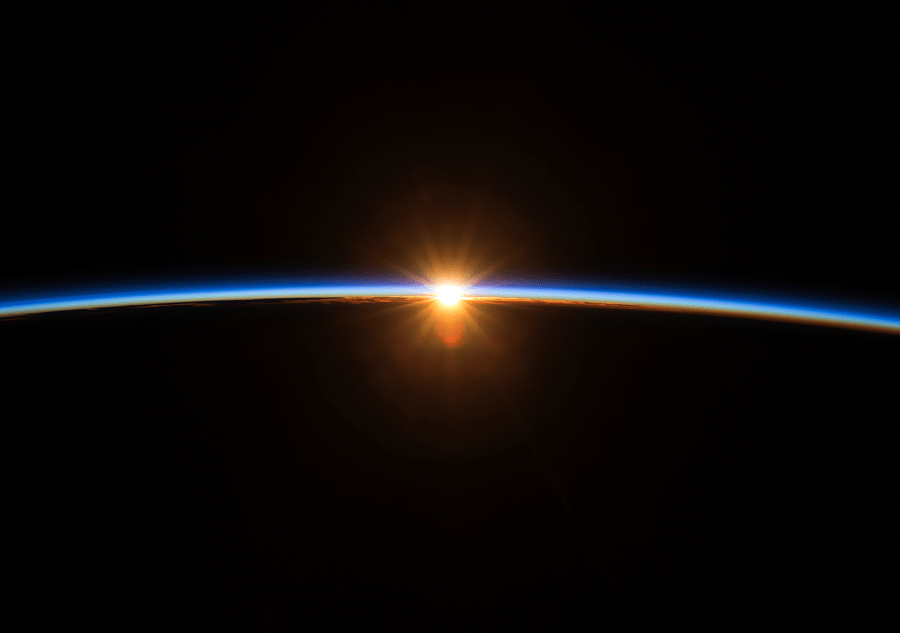
Sunrise over the Earth as seen from the International Space Station
This meant that each time the ISS crew changed during the 18 months it took to complete the film, the members of each mission had to be trained to use the digital cameras and given some tips and tricks on storytelling and cinematography. (Fortunately, astronauts are pretty quick studies when it comes to technology.) But technology aside, it was left to the astronauts to capture the images and crew moments through their own eyes.
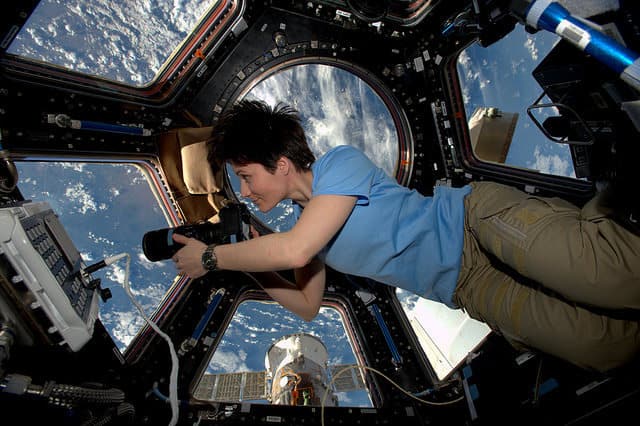
Italian Astronaut Samantha Cristoforetti shooting stills for A Beautiful Planet
Director Myers wanted the finished film to be much more than just a scientific documentary showcasing the technology and achievement inherent in the Space Station itself. By giving the astronauts creative control and the freedom to interpret what they see through their own lens, they are made more human and relatable. In turn, they become planetary ambassadors who communicate a larger message to all of us – that we are all dependent on one another if we want to ensure our future as human beings – and the future of the planet we call home. It’s a lasting and profound realization that many astronauts have felt, something that has been called the ‘Overview Effect’.
The “Overview Effect”

A Beautiful Planet it is.
The “Overview Effect” was first described in 1987 by author Frank White as the transformative experience many astronauts feel after seeing our planet from space. Astronauts have acknowledged this perspective as life-changing, and one that drives home the reality of the interconnection of all life on our planet, and the need to take greater responsibility for our environment. (Watch an inspiring video where astronauts describe this experience in their own words.)
In A Beautiful Planet, this same sentiment is articulated by Samantha Cristoforetti, the Italian astronaut who likens planet Earth to a starship that protects all of us with its fragile and life-sustaining atmosphere – not unlike the Space Station that is keeping herself and her other crew members safe. It’s especially appropriate hearing a woman voice this view of ‘Mother Earth’, (and undoubtedly why Toni Myers chose another woman, actress Jennifer Lawrence, to narrate the film.)
Another astronaut remarks that from space, there are no borders visible, at least not during the day, when clouds swirl above land and oceans with only the shapes of the continents themselves defining the geography. But come nightfall, the brightly-lit cities, towns and shorelines help to outline the shapes of states and countries, revealing Florida’s panhandle or Italy’s ‘boot’. You can hear the excitement as the astronauts describe familiar places they recognize as home.
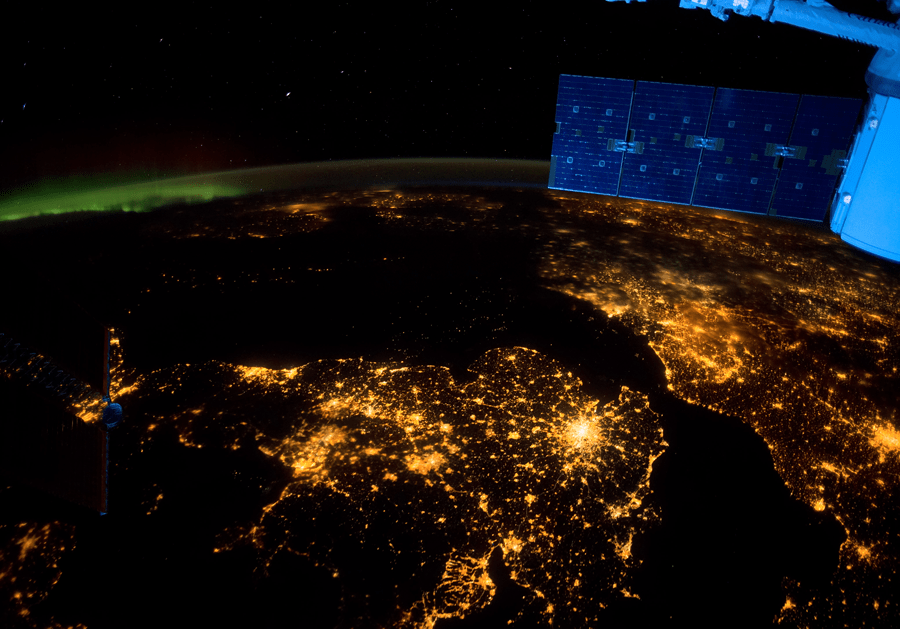
London is lit up with Paris visible on the far right
Unfortunately, nighttime also reveals those other borders that are not geographic: a dramatic line is clearly drawn between South Korea, brightly-lit with its network of roads and cities, and an equally populous North Korea that appears dark and uninhabited. A similar division is visible between India and Pakistan where the brightest lights are the ones on the border between nations. Politics, it would appear, are visible from space.
Sad, too, are the devastating signs of pollution that are seen on a frightening scale. The astronauts’ footage captures huge expanses of man-made deserts, clear-cut swaths where rainforest once stood, and massive rivers that are visibly choked with toxic brown runoff spilling into the sea. The destruction is obvious to the astronauts who can see the ‘bigger picture’ and perhaps it is because of this, that the need to protect the planet is felt so profoundly by those floating above it. And now thanks to this film, by those of us on the surface as well.
Mission accomplished, then, for Toni Myers, and her crew of astronaut-filmmakers, editors and sound designers. Because A Beautiful Planet, like the Space Station from which it is shot, is the work of many people working together with a common vision. And the message that it communicates is truly inspiring.
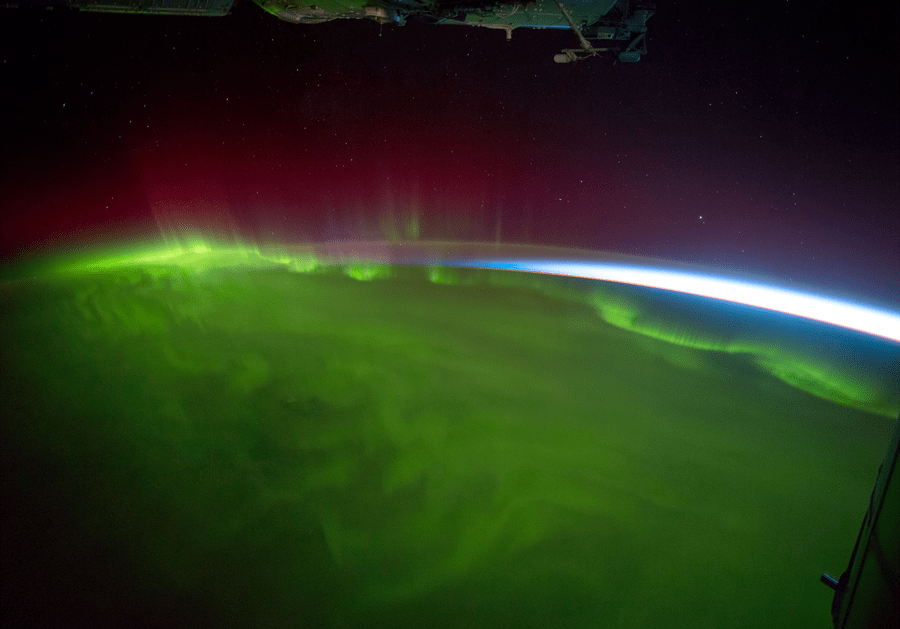
The Northern Lights as seen from the ISS
A Beautiful Planet opens at the Ontario Science Centre April 29, 2016. For more information visit the website.
Special thanks to the Ontario Science Centre who invited me to the premiere, and provided the photos in this post.

Jane is an award-winning travel writer and photographer and an accredited member of the Travel Media Association of Canada (TMAC). In their annual awards competition, TMAC named GrownupTravels.com as the Best Self-Published Travel Blog in 2025 .
She is also a member of the North American Travel Journalists Association, and a freelance travel writer contributing to both print and online publications.






Subscribe and you'll never miss an update!
Join our mailing list to receive the latest news and updates from Grownup Travels. (We keep your email STRICTLY private)
Thank you for subscribing to Grownup Travels!