

All it took was seeing one photo online of a very particular house and I was booking a ticket to go see it for myself. The house happened to be an Art Nouveau-era building known as House of the Five Continents, just one example of many stunning examples of architecture in Antwerp, but the instant I saw this building (and confirmed that it was not an AI-generated image), I was enamored.
Just to be clear, the ticket I was booking was a train ticket, not a plane ticket, as Henk and I were already in Belgium, staying in Bruges. But still, this house was reason enough for me to plan a visit to Antwerp. It’s not the first time that a singular place or image has inspired me to travel somewhere, but as it turned out, there was even more wonderful eclectic architecture in Antwerp to discover in this beautiful Belgian city – and a few other visual surprises as well.
The Antwerp-Centraal Train Station
The best place way to start any visit to explore the architecture in Antwerp has to be by arriving at its Centraal Train Station. As first impressions go, it doesn’t get much better than this, especially when your train pulls into the main level platform like ours did. Directly in front of us was the platform-facing facade of what many have described as the most beautiful train station not just in Europe, but in the world. (Porto’s azulejo-clad train station also vies for the European title.) And after seeing Antwerp Centraal in person, I have to say that it definitely makes a good case for claiming a global title.

Perhaps the beauty of the Antwerp-Centraal station is that it doesn’t really fit into any singular architectural style, but is rather a mish-mash of several. Bruges architect Louis Delacenserie completed the station in 1905 and supposedly once described its style as “Baroque-medieval eclecticism”. He was also influenced by the Pantheon in Rome, with the creation of a modern steel and glass dome over the interior courtyard space, another nod to centuries-past design icons.

The interior of the station under that dome is equally impressive as the facades: from the train, you descend a grand staircase (that doubles as a backdrop for traveller photos) and enter a space surrounded by what could be Italian palazzos from the Renaissance.

It’s hard to take it all in, to be honest, especially as a first-time visitor, even with a 360-degree camera or video. But we certainly tried, spinning around with cameras in hand in an attempt to capture it all.

The Golden Triangle in the Zurenborg Neighbourhood
Already impressed within mere moments of our arrival, Henk and I set off to a neighbourhood known as Zurenborg, which research had told me was a good place to start when it comes to exploring some of the most interesting architecture in Antwerp. Our first stop was Dageraadplaats square where we stopped into a little cafe for a hit of caffeine, and spoke with the owner, explaining why we were in the neighbourhood. He actually recommended two things: firstly that we start with a stroll down Transvaal Street, which is part of the Art Nouveau ‘golden triangle’ that also includes Cogels-Osylei and Waterloo streets; and secondly, that we check out a mural installation nearby that was part of a 2023 Street Art Festival on Krugerstraat. Always deferring to locals, we followed his advice and headed to Transvaal Street first.

FUN FACT: Art Nouveau actually has its roots in England, with the Arts and Crafts aesthetic of William Morris and the work of English illustrator Aubrey Beardsley. But it was in Brussels where the actual term ‘art nouveau’ was coined by the periodical L’Art Moderne, used to describe the work of 20 painters and sculptors known as Les Vingt.

Transvaal Street, Antwerp
Eclectic is definitely the word to describe the architecture on Transvaal Street and would soon come to describe the whole Golden Triangle, in fact. In the space of one block, we saw everything from traditional red brick structures to neo-classical palazzos with pediments and statuary, standing practically next door to each other.

One house even had a black wooden half-timbered facade with balconies supported by a line of 12 carved winged gargoyles.


Clearly here, every homeowner is free to express themselves and their own personal taste in architecture, which is one of the reasons why these streets are so interesting.

Waterloo Street, Antwerp
Continuing around the base of the ‘golden triangle’ onto Waterloo Street, Henk and I spotted our first significant Art Nouveau house, the Den Tijd house (the Time house), designed by August Cols and Alfried Defever. This 1903 structure is actually made up of 5 houses that form a symmetrical set, themed around the concept of time. (‘Den dag’ and ‘De Nacht’ are written on the houses inside tiled murals at the top, and mean ‘the Day’ and ‘the Night’ respectively).

Halfway up Waterloo Street, we saw a quartet of themed buildings facing each other across an intersection, with decorative panels depicting one of the Four Seasons mounted on the front of each. These nature-inspired themes are a big part of Art Nouveau and appear in the organic shapes of architectural details surrounding windows, balconies and even on the design of interior doors and their hardware.

The ‘whiplash’ curves in the window surrounds is a particular signature of Art Nouveau style, and one of my favourite elements.

Cogels-Osylei Street: the Crown Jewel for Architecture in Antwerp

Transvaal and Waterloo Streets turned out to be mere supporting players to Cogels-Osylei Street, where the true extent of Antwerp’s architectural eclecticism is on display, including some very impressive Art Nouveau examples.

The entire street is just one beautiful building after another, punctuated by a roundabout in the middle where all 4 corners are populated with matching white apartment buildings.

Styles range from Gothic to Renaissance, to neo-Baroque, Romanesque and Tudor, and there is even the occasional modern example thrown in, keeping the tradition of architectural freedom of expression alive here, even today.
Murals from Street Art Festival in 2023
Before leaving the Zurenborg neighbourhood with its Golden Triangle, we heeded the advice of our friendly barrista and headed to Krugerstraat to check out the murals that were created for the 2023 Street Art Festival that took place here.
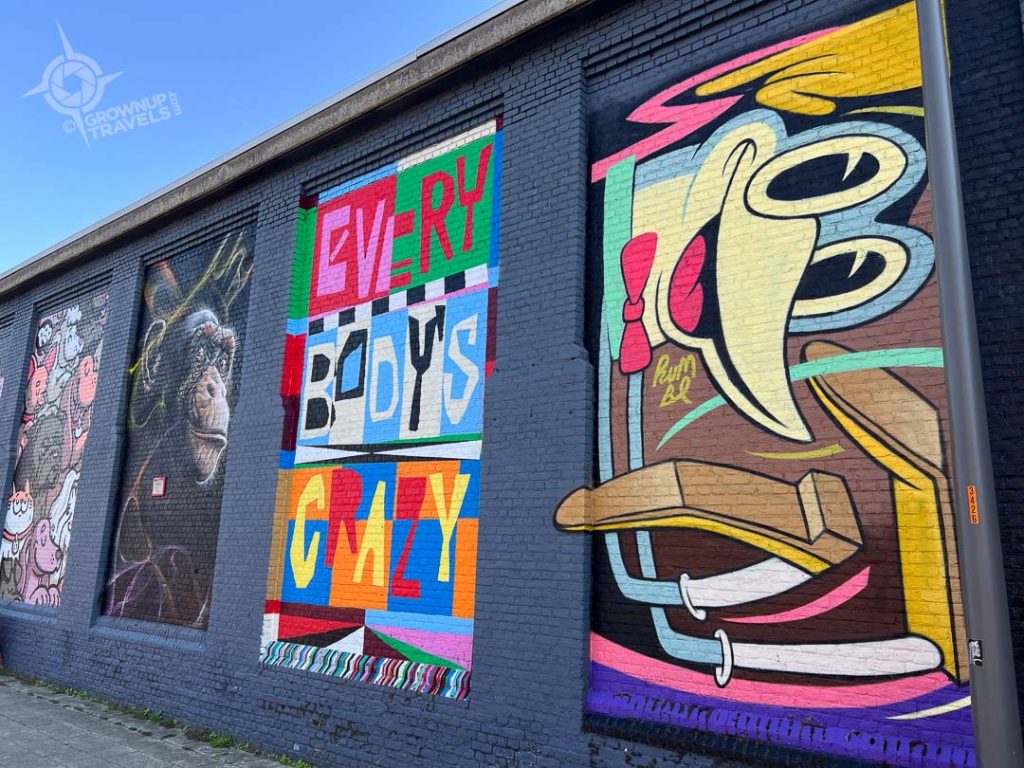
Here the city took advantage of the surrounding walls of a now-defunct streetcar rail yard and re-purposed them as canvases for huge artwork by international street artists.

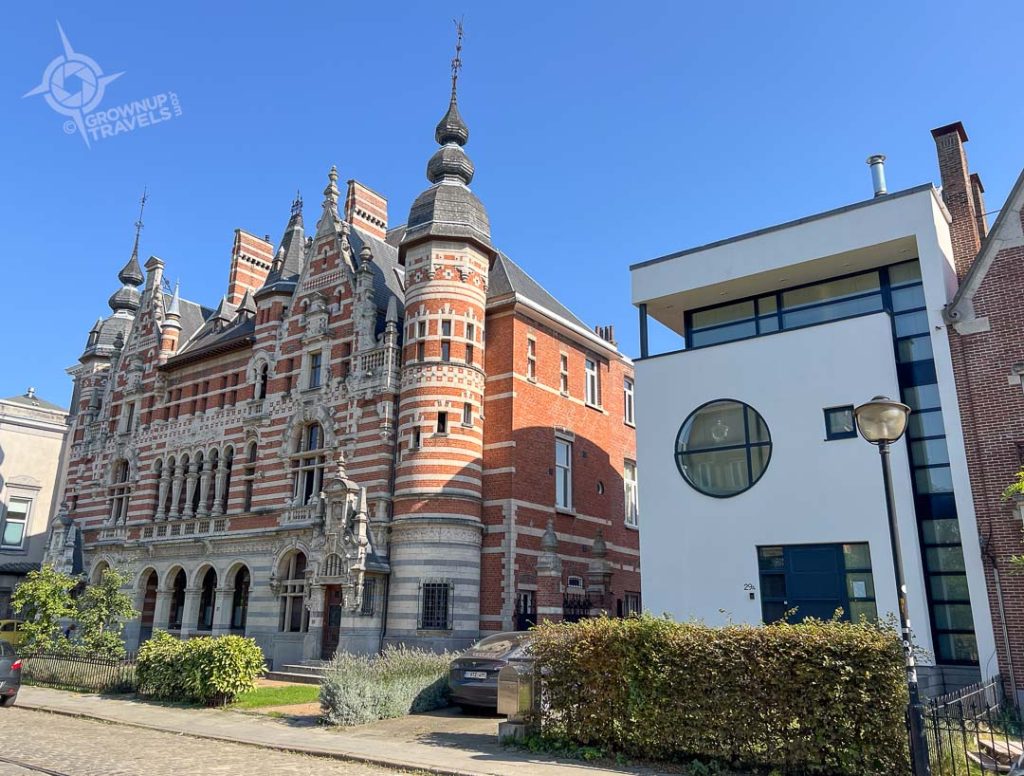
The Inspiration for our Visit: The House of the Five Continents
Like waiting for the headliner at a concert, it was finally time for the main event: the house that had inspired our visit to explore architecture in Antwerp in the first place – the House of the Five Continents.

Located in the Zuid neighbourhood, this house dates from 1901 and was designed by Belgian architect Frans Smet-Verhs for the home’s shipbuilder owner, P. Roeis. But Roeis was a very participatory client and requested that a particular element reflecting his occupation be included in the design: a 5-sided loggia sitting atop a ship’s prow that juts out from the corner of the building.
TIP: The description of the ‘House of the Five Continents’ references the 5 sides of the ship’s loggia, with each side representing one of the five continents, another nod to the maritime occupation of its owner.

Quirky, whimsical, no doubt controversial (not sure how the neighbours may have felt about it at the time), this house immediately got the nickname ‘Het Bootje’ (the Little Boat) for obvious reasons. But it’s not just the ship’s prow that is spectacular here…the circular window, the alternating brickwork, the covered terrace, and even the doors are quintessentially Art Nouveau.

The building was actually comprised of 4 houses (one of which was torn down in the 1970s) and every side of it is interesting and unique, enough so that it definitely hold its own against other more imposing neighbours.

Love it or hate it, I absolutely loved it. And I imagine the people who live in it today must feel the same way.
TIP: If you are loving these examples of Art Nouveau architecture in Antwerp, you can get more detailed descriptions and information on Art Nouveau houses all around Belgium, at this site.
Gothic Architecture in Antwerp: the Cathedral of Our Lady
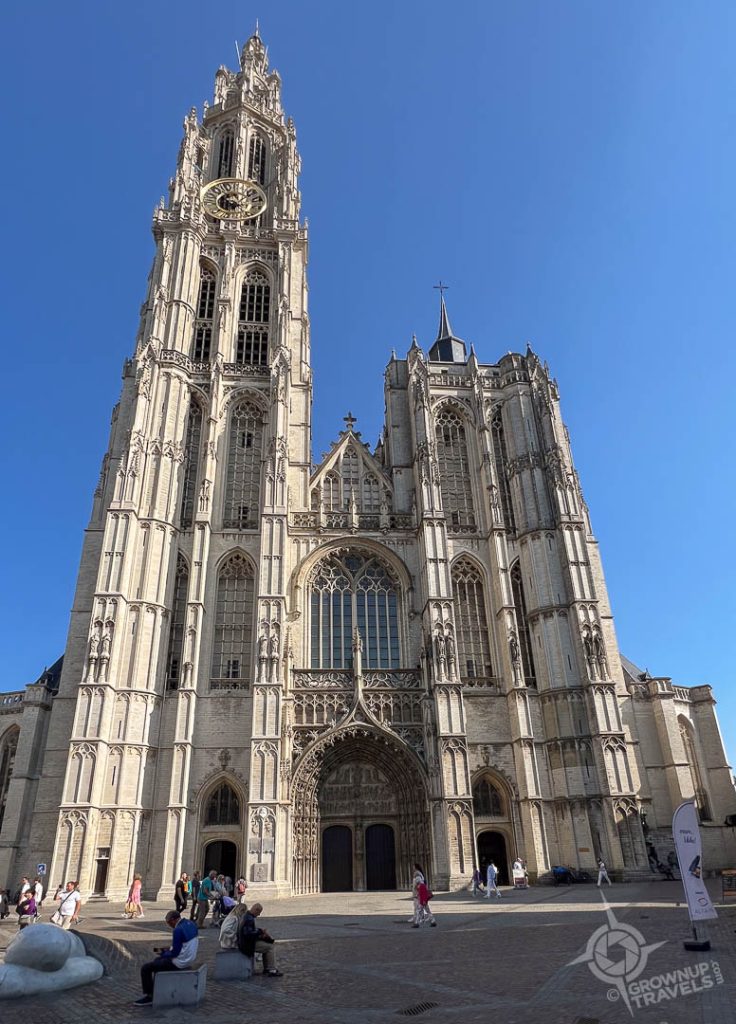
No discussion about architecture in Antwerp can exclude one of the most important landmarks in the city: the Cathedral of Our Lady, a more ‘traditional’ late Gothic church that is also home to several artistic masterpieces by the city’s most famous son: Peter Paul Rubens.

This church was begun in 1352 and is still incomplete, although the first stage of its construction was finished in 1521, and included the 123-metre tall bell tower which makes this the tallest building in the city.
But it was actually the juxtaposition of a modern sculpture at the base of this historic church that struck us as very typical of Antwerp: the sculpture of Nello and Patrasche, that seems to be ‘tucked in’ under the cobblestones of the square. These characters are from an 1872 book called A Dog of Flanders, and the sculpture was created by Batist ‘Tist’ Vermeulen and installed here in 2016. The Cathedral and its artwork play a significant role in the story, hence the location of the sculpture.

TIP: If you want to watch the vintage tear-jerker movie based on the book upon which this sculpture is based, watch A Dog of Flanders movie on YouTube. It had me teary-eyed as a young girl and apparently the story took Japan by storm, even spawning an Animé series in the 90s, which in turn has inspired many Asians to visit Antwerp. Who knew?
Flemish Architecture in Antwerp: the Grand Place

And of course, like so many Belgian cities, Antwerp is home to its own Grand Place, the Grote Markt, a stone’s throw from the Cathedral and home to some stunning examples of Baroque guild-houses. These stepped-gable designs are typical of 16th century Flemish architecture in Antwerp and represent the various trades that flourished here (from skinners to cobblers). Atop many of these are gilt statues that represent animals, the patron saints for the guilds or angels.
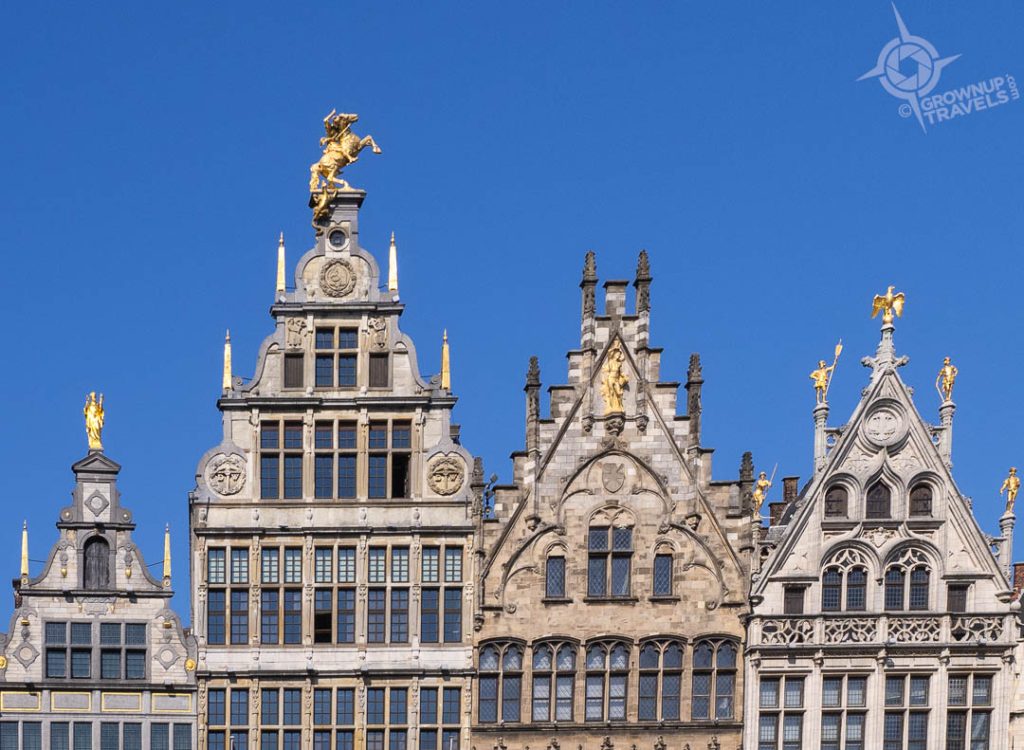
The City Hall is no slouch, either, which is built in the Flemish-Renaissance style and flies flags from all the countries that have a consulate in the city.
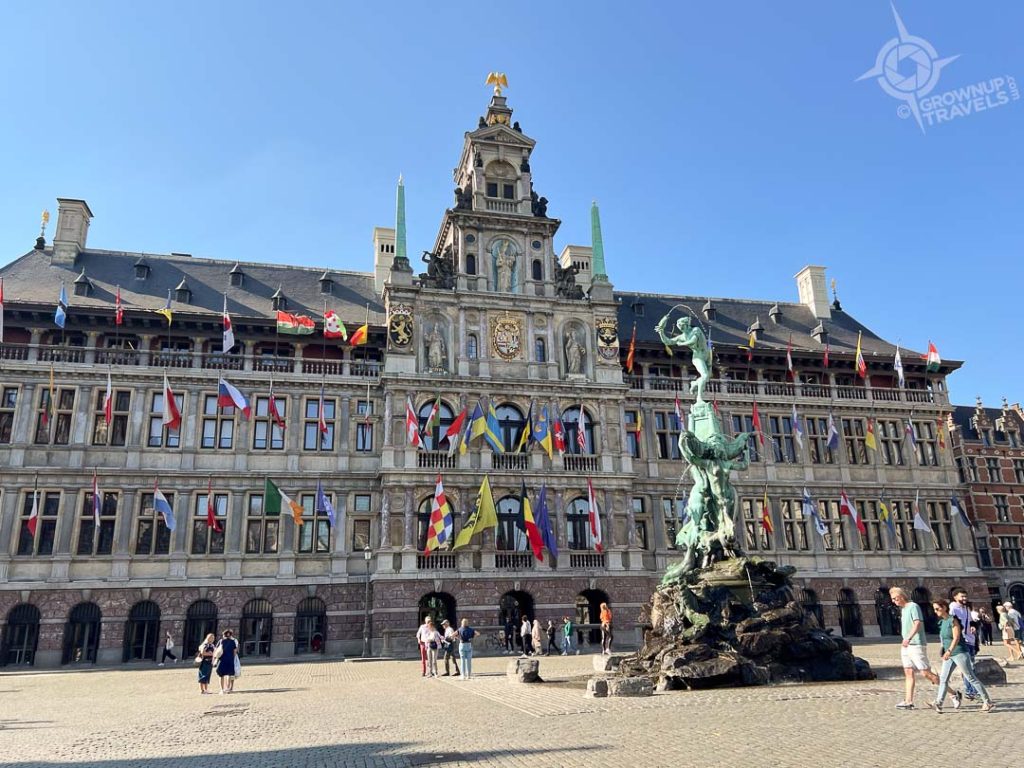
But what makes this particular square unique is the fountain in its centre, the Brabo Fountain that depicts the legend after which Antwerp was named.
The legend tells of a menacing (and greedy) giant named Druon Antigonus who would demand a high toll from all ships entering Antwerp’s port, and if they refused to pay, the giant would cut off their hands. Silvius Brabo, a mythical Roman soldier, fought the giant and won, cutting off the giant’s own hand and throwing it into the river. The Flemish name for the city, Antwerpen, comes from this, from the Dutch handwerpen (meaning ‘to throw a hand’).

Architecture in Antwerp: Something for Every Taste
Although it was one particular quirky Art Nouveau house that drew me to Antwerp in the first place, (the House of the Five Continents did NOT disappoint!), it was the diversity of architecture in Antwerp that turned out to be the real surprise here. And even with only one day to explore some of that architectural history, our wanderings uncovered some of the other visual treats this city has to offer visitors, from street art to Renaissance masterpieces and even cultural icons that have found an unexpected Japanese following.
Clearly, we should have allowed more time to explore Belgium’s ‘second city’ – something we would highly recommend to other visitors as well. That, and to be sure to arrive by train.


Jane is an award-winning travel writer and photographer and an accredited member of the Travel Media Association of Canada (TMAC). In their annual awards competition, TMAC named GrownupTravels.com as the Best Self-Published Travel Blog in 2025 .
She is also a member of the North American Travel Journalists Association, and a freelance travel writer contributing to both print and online publications.






Subscribe and you'll never miss an update!
Join our mailing list to receive the latest news and updates from Grownup Travels. (We keep your email STRICTLY private)
Thank you for subscribing to Grownup Travels!